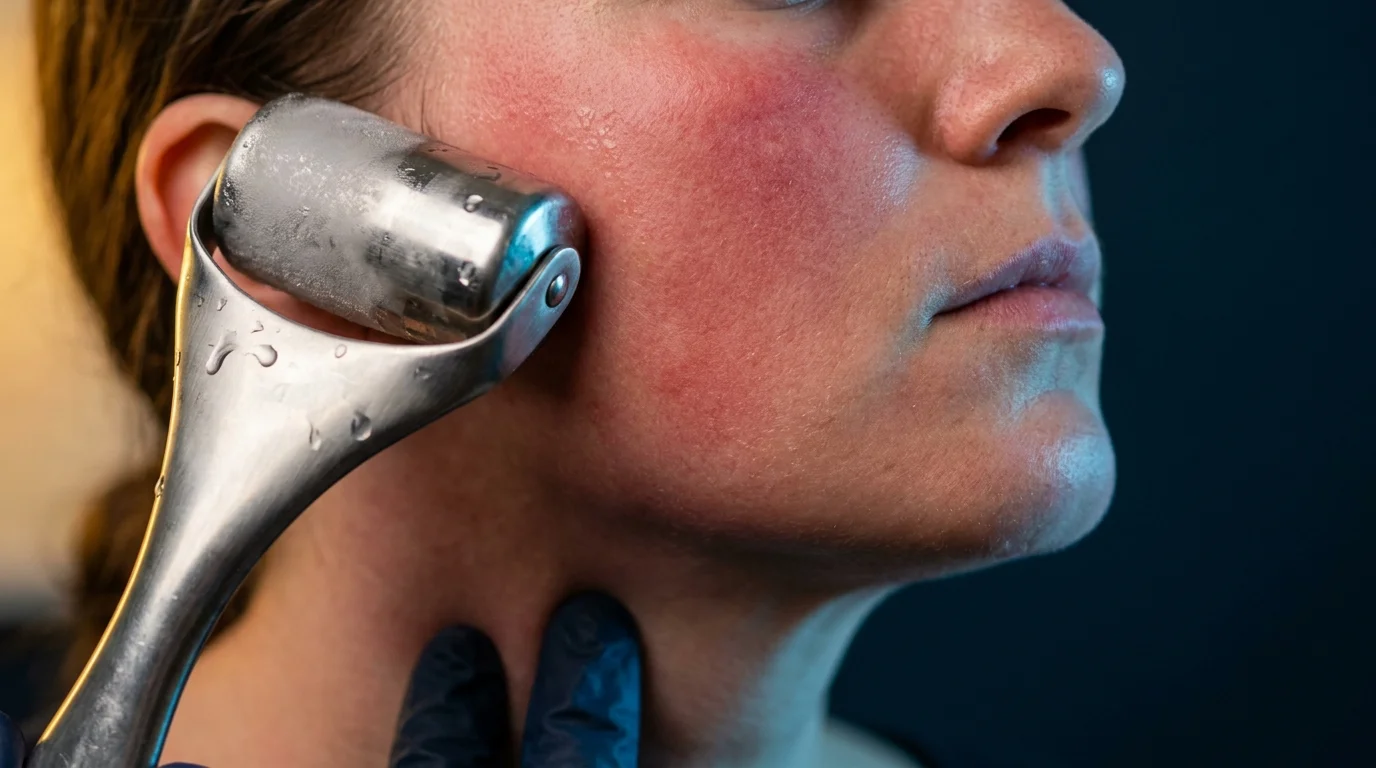
The bathroom mirror holds the steam of an early shower, soft and damp against the morning quiet. You reach into the freezer compartment, past the frozen blueberries, to retrieve a heavy cylinder of surgical-grade metal. It feels like an icicle cast in polished industrial alloy, frosted over with a faint, crystalline crust that melts instantly against the heat of your thumb. The promise is crisp: tighten tired pores, sculpt the jawline, and chase away the dull puffiness left behind by poor sleep.
You press the chilled cylinder directly against your cheekbone, dragging it upward toward the hairline. The initial shock makes you catch your breath, a sudden, sharp cold that stings the skin into numbness. It seems restorative on the surface, an icy slap to wake up sluggish circulation. Yet within three strokes, something curious shifts beneath the surface of your skin.
A faint flutter begins behind your eyes, accompanied by a dull, throbbing pressure along your left temple. Moments later, as your hand holds the frigid handle, your fingertips grow numb and tingle with an odd, prickling ache. What felt like an innocent aesthetic reset has quietly triggered an ancient, involuntary reflex deep within your vascular architecture.
We have been taught that cold is simply an eraser for inflammation, a mechanical switch we can flip to drain fluid and sharpen bone structure. But treating delicate facial anatomy like bruised muscle tissue overlooks the intricate communication between your skin and your autonomic nervous system. Your face is not an isolated canvas; it is a primary command center for whole-body blood flow.
The Dive Reflex Betrayal: When Cold Becomes a Threat
When you press freezing stainless steel directly to warm facial tissue, your physiology does not recognize a beauty ritual. It registers an existential threat akin to plunging through cracked ice into arctic water. The trigeminal nerve, the massive sensory highway fanning across your forehead, cheeks, and jaw, detects the instantaneous drop in temperature and fires an emergency signal directly to your brainstem.
The response is swift and uncompromising. To protect your vital organs from perceived hypothermia, your body initiates violent peripheral capillary vasoconstriction. The microscopic vessels feeding the surface of your face snap shut like clamped hoses. Because stainless steel possesses exceptional thermal conductivity—far higher than traditional jade or rose quartz—it drains thermal energy from your skin at an unnatural, predatory rate.
This sudden shutdown forces blood to reroute under heightened pressure. As facial microvessels constrict to a microscopic fraction of their normal diameter, systemic vascular resistance spikes. The blood forced away from the facial surface pools backward, creating a sudden wave of pressure inside the cranial arteries. That dull, rhythmic ache pulsing at your temples is not tension leaving your brow; it is vascular recoil.
- Skipping yard raking erodes natural core balance leaving frail slumping posture in adults
- Premier Protein shakes spike sudden afternoon cravings leaving sticky tongue dryness
- Cefepime antibiotic dosing shifts hospital protocols following sudden neurological toxicity warnings
- Avocado oil searing releases airborne irritants triggering burning sinus pressure and heavy fog
- Reverse osmosis water flushes essential cellular electrolytes triggering parched mouth and midday exhaustion
At the same time, this sympathetic panic spreads down the spinal cord. The nerves regulating your extremities interpret the facial freeze as whole-body exposure, constricting blood vessels in your hands and feet. Within seconds of rolling ice across your cheekbones, your fingertips turn waxy, pale, and prickle with pins and needles as their microcirculation stalls.
The Microvascular Reality Behind the Mirror
Dr. Eleanor Vance, a vascular neurologist based in Chicago, spent years tracking unexplained morning migraines in her patients before looking beyond their prescription lists. She observed a consistent cluster of mid-morning vascular headaches in women who adhered to rigorous cryo-toning protocols before work. The culprit was rarely their caffeine consumption or eye strain; it was the two-pound steel roller sitting in their freezer trays.
When Vance evaluated these patients using capillary blood-flow monitors, she noticed that extreme localized cooling provoked an immediate reflex loop. The severe constriction was routinely followed by an erratic, inflamed rebound dilation twenty minutes later. The very redness and puffiness the roller was meant to banish returned with aggressive, throbbing interest once the tissue fought its way back to room temperature.
Mapping the Vascular Response: Finding Your Baseline
Not every face responds to rapid temperature drops in the exact same manner. Your autonomic reactivity, vascular tone, and skin thickness dictate how much thermal shock your system can absorb before triggering a migraine or peripheral numbness. Recognizing where your tissue lands on the spectrum helps you avoid shocking your nervous system.
The Reactive Vasomotor Profile
If you flush red after a sip of warm broth, develop chilled hands while typing in an air-conditioned room, or experience lingering temple soreness after eating ice cream, your vascular tree is hyper-responsive. Applying freezing steel directly to your cheeks will almost instantly spark sharp cranial nerve pain and peripheral tingling. For this profile, frozen metal acts like an electric shock to the trigeminal pathways.
The Dense Structural Profile
Those with thicker, oil-rich dermis and lower baseline autonomic sensitivity may tolerate cooling longer without an immediate headache. However, the internal consequence remains identical. Micro-capillaries underneath the skin can rupture under rapid contraction-expansion cycles, leading over time to persistent spider veins around the nose and upper cheeks. Even when pain signals stay muted, mechanical stress continues below.
The Thermal Reset: A Mindful Approach to Morning Drainage
Puffiness is simply stagnant lymph fluid searching for a gentle pathway down the neck, not a structural flaw that requires sub-zero force to crush. Lymphatic vessels are fragile, unmuscular channels nestled just under the skin. They respond far better to light pressure and mild, comforting temperatures than to freezing steel.
You can achieve sculpted, waking brightness without provoking autonomic panic by recalibrating how you store and handle your tools.
- Store your tools in the refrigerator door rather than the freezer. A resting temperature between 45°F and 50°F provides adequate depuffing without triggering trigeminal vascular shock.
- Warm the tool slightly with your fingers before it touches your temples or jaw. Allow the surface frost to disappear entirely.
- Glide with featherlight intention. Use the weight of the roller itself, never pushing down into the underlying bone or muscle belly.
- Follow the lymphatic exit pathways down toward the collarbone. Never roll aggressively upward and backward into the sensitive temple junction.
- Limit contact time to three minutes across the entire face, keeping the tool in continuous, sweeping motion.
By moving from freezing shocks to gentle coolness, you invite calm, fluid lymphatic drainage without sending your circulatory system into a defensive tailspin.
The Bigger Picture: Reclaiming Harmony with Your Skin
In our modern pursuit of rapid visual fixes, we frequently view our bodies as machines to be hammered, frozen, or forced into submission. We pull ice from the freezer expecting our skin to behave like inanimate clay, forgetting that every square inch of our face is woven with living sensory nerves and delicate, pulsing blood vessels.
When you stop shocking your tissues and begin working in rhythm with your physiology, the frantic struggle against puffiness dissolves. True facial vitality does not stem from numb, constricted capillaries; it rises from balanced blood flow, relaxed cranial nerves, and a quieted nervous system. When you lay down the freezing metal, your hands stay warm, your temples rest easy, and your skin finds its natural, steady glow.
Treat your facial circulation like a resting stream, not an inflamed fire that requires ice to extinguish.
| Key Point | Detail | Added Value for the Reader |
|---|---|---|
| Thermal Shock | Freezing steel drops surface skin temperature by up to 30°F in under ten seconds. | Prevents accidental damage to delicate surface capillaries and stops broken veins. |
| Trigeminal Irritation | Intense cold overstimulates cranial nerves, prompting sudden arterial spasms in the temples. | Eliminates the mysterious mid-morning headaches often blamed on work stress or coffee. |
| Diverted Blood Flow | Facial vasoconstriction triggers reflexive blood vessel tightening in the hands and feet. | Restores full-body warmth and ends distracting numbness during morning routines. |
Frequently Asked Questions
Why do my fingers tingle when I use an ice roller on my face?
The trigeminal nerve on your face signals systemic hypothermic danger to your brainstem, triggering a full-body survival reflex that constricts peripheral blood vessels in your hands and feet.Is stainless steel worse for the skin than natural jade or quartz?
Yes, because stainless steel possesses much higher thermal conductivity. It transfers extreme cold into tissue significantly faster than stone, greatly increasing the risk of vascular shock.Can ice rolling cause permanent broken capillaries?
Yes. The rapid cycle of severe vasoconstriction followed by aggressive rebound vasodilation places immense mechanical strain on thin facial capillary walls, occasionally causing them to rupture permanently.What is the safest temperature for morning depuffing tools?
Keep tools between 45°F and 52°F by storing them in the refrigerator, not the freezer. This range reduces fluid retention without triggering cranial nerve spasms.How long should a cooling facial massage last?
Keep the routine under three to five minutes. Use continuous, sweeping downward strokes toward the base of the neck, and avoid lingering over the temples or orbital bones.