You slide beneath cool percale sheets after a fourteen-hour day on your feet, and then comes that sharp, sandpaper catch. Your heel snags the woven cotton with an audible rasp, sending a needle of sudden pain straight through the skin. It is a tiny, stubborn canyon in the stratum corneum—a fissure that turns every morning step across cold hardwood into an exercise in wincing.
Most evenings end with a desperate smear of white, petrolatum-heavy drugstore lotion. You pull on an old sock, hoping the greasy barrier performs some kind of miracle before dawn, only to wake up to the exact same rough, split edges. The cream simply sat on top of the dead tissue like cold butter on stone, doing nothing to close the chasm.
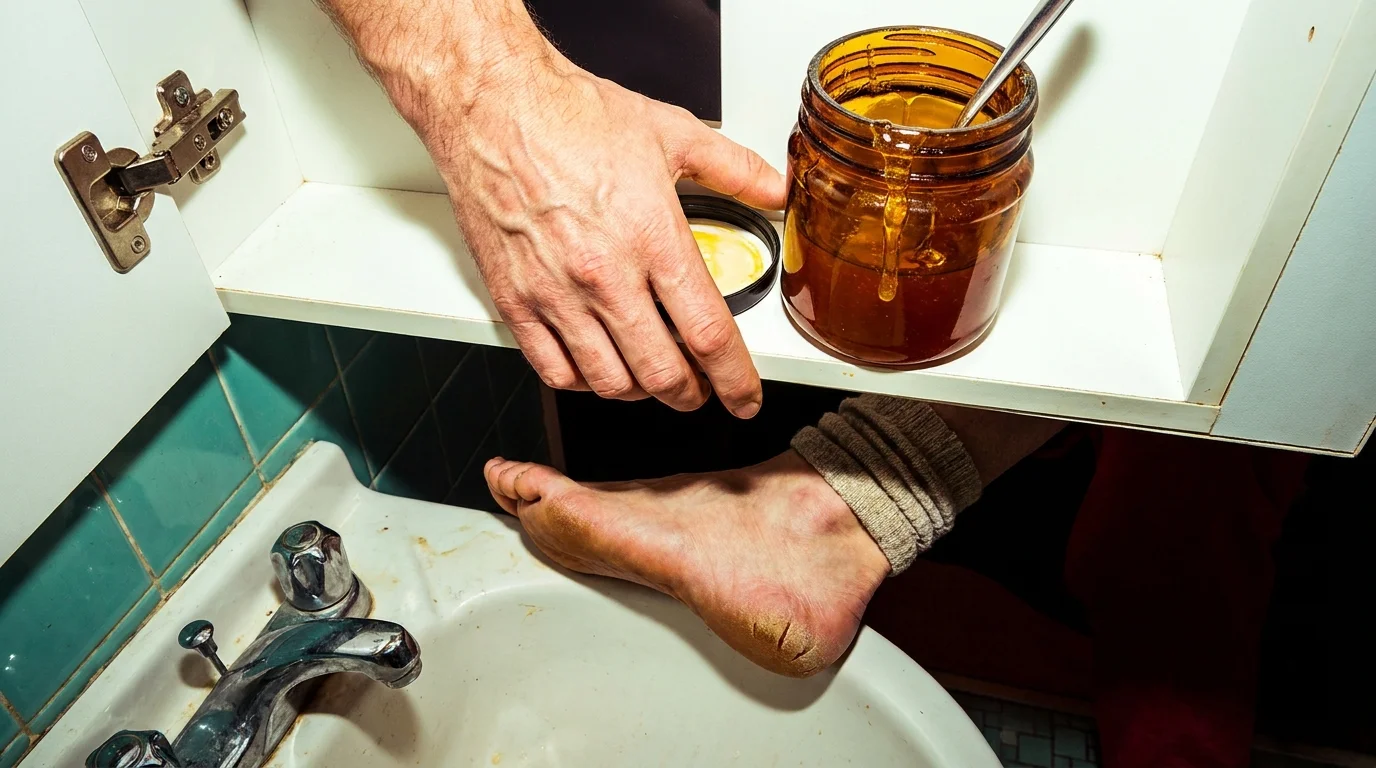
The secret to mending that split does not live in synthetic chemical moisturizers or violent pumice stones. It sits in a jar of dense, dark amber resin harvested from wild tea tree blooms in New Zealand: raw manuka honey. By working alongside your body’s natural cellular pressure rather than fighting it, this viscous floral nectar works overnight to pull fluid upward and knit broken skin together.
When you coat a clean split with thick, unheated manuka and encase it beneath breathable fiber, you are not just moisturizing. You are initiating an osmotic wound seal that transforms brittle edges into pliable, healed tissue while you sleep.
The Osmotic Weld: Why Honey Heals Where Creams Fail
We are conditioned to treat dry heels like a cosmetic nuisance to be scrubbed, planed, and filed away until raw. But a cracked heel is an actual dermal wound—a mechanical split created when dried-out keratin plaques shear apart under your body weight. Scrubbing a fissure with a metal rasp only triggers the skin to defend itself by producing thicker, tougher calluses that split twice as easily.
Raw manuka honey flips this dynamic entirely through a principle known as high osmotic draw. Because pure, unadulterated honey possesses virtually zero free water, its high natural sugar concentration exerts a steady, gentle suction on the underlying dermis. It pulls lymph fluid, blood plasma, and cellular moisture upward from the healthy lower tissue into the base of the crack, hydrating the fissure from the inside out.
At the same time, active floral enzymes like glucose oxidase release microscopic, sustained amounts of natural hydrogen peroxide as they meet skin moisture. Combined with high concentrations of methylglyoxal (MGO), this creates a pristine, sterile cocoon that suppresses subclinical surface bacteria, relieving the low-grade inflammation that keeps fissure walls hard, red, and tender.
Instead of acting as a superficial grease slip, honey behaves like biological glue, softening the jagged margins and coaxing the skin edges back into alignment.
- Levator scapulae muscles trap chronic workplace micro-stress triggering burning neck and shoulder aches
- Grapeseed cooking oil releases stinging fumes triggering heavy sinus pressure and sudden brain fog
- FitCrunch protein bars spike blood sugar triggering violent afternoon crashes and intense cravings
- Anticipating unspoken moods drains neural stamina sparking restless sleep and chronic physical exhaustion
- Smartwater distilled bottles drain cellular minerals triggering persistent afternoon fatigue and dry mouth
The Clinical Secret from Post-Surgical Recovery
Elena Ward, a 48-year-old certified wound-care specialist based in Boise, Idaho, spent decades watching standard barrier creams fail patients with chronic plantar fissures before she took a cue from clinical burn units. “In trauma wards, we do not throw scented, wax-heavy emollients over split margins,” Ward notes quietly. “We use medical-grade Leptospermum honey under light compression.”
Ward began sharing the protocol with colleagues who spent twelve-hour shifts on hospital tile floors, suffering from stinging heel fissures that split open every winter. The instructions were simple: abandon the aggressive foot rasps, apply raw, high-UMF honey straight to the crack, and lock it down with dense, unbleached cotton overnight.
Within a single night, the sharp stinging vanished. By night three, the visible fissures had closed into smooth, pink epidermal tissue. As Ward puts it, raw manuka delivers the one thing dry skin cannot generate on its own: an enzyme-rich micro-climate that makes cellular repair effortless.
Tailoring the Method: Finding Your Application Layer
Not every foot carries the same kind of damage. Depending on your daily routine and foot mechanics, subtle tweaks to the ritual deliver the fastest relief.
For the Barefoot Pacer and Athlete
If you spend hours walking barefoot at home, lifting heavy weights, or logging trail miles, your cracks are likely seated inside broad, yellowed calluses. For this profile, application requires a preparatory softening step.
Soak your feet for no longer than seven minutes in warm water with a tablespoon of coarse sea salt. Pat the skin completely dry with a clean towel, leaving zero standing water inside the fissure. Dab a generous pearl of raw manuka directly into the canyon, pressing it into the groove with the back of a spoon before covering.
For the Office Professional in Structured Shoes
Heels that spend the day trapped in rigid leather loafers or heels suffer from constant lateral friction and restricted air circulation, leading to shallow, intensely stinging micro-tears around the rim of the foot.
Skip the pre-soak, which can over-hydrate and weaken already thin skin. Instead, apply a thin, targeted ribbon of manuka along the entire curved margin of the heel. The floral enzymes will dissolve the microscopic jagged edges without loosening the surrounding healthy skin.
For the Sensitive and Reactive Skin Type
If commercial foot lotions make your ankles flare with contact dermatitis or red bumps, raw manuka serves as an unadulterated, single-ingredient savior free of emulsifiers, parabens, and synthetic fragrance.
Ensure you select an unpasteurized manuka honey labeled with at least UMF 10+ or MGO 250+. Warm the jar between your palms for two minutes to make the amber paste silky and easy to spread without tugging at raw fissures.
The Overnight Protocol: Mindful Application
This evening routine takes under four minutes to set up. Treat it as a grounding physical wind-down before your head hits the pillow.
- Check your soak temperature: If you soak, keep water strictly warm (roughly 100°F), never scalding. Hot water dissolves your skin’s protective lipid mantle, worsening deep cracks.
- Leave the surface dry: Moisture repels honey. Ensure the fissure is bone-dry before touching it with the nectar.
- Dose with precision: Use a nickel-sized dollop per heel. Too much will leak past your socks; too little will not maintain the osmotic seal.
- Deploy the double-sock method: Pull on a thin, 100% unbleached cotton sock first to absorb and hold the honey directly against the skin. Layer a thicker wool sock over top to generate gentle warmth, which activates the floral enzymes.
When you pull the socks off in the morning, rinse with simple lukewarm water, avoiding harsh bar soaps. You will notice the angry red borders have faded to a soft, quiet pink, and the deep, stinging bite of the crack has disappeared entirely.
The Ground Beneath You
There is a profound mental shift that occurs when you resolve a chronic physical discomfort using a simple jar from your pantry. You stop looking at your body as a collection of worn parts that require harsh chemical interventions and aggressive scraping tools. You realize that stubborn, cracked heels do not need punishment—they need nourishment, biological quiet, and the right protective barrier.
Stepping out of bed onto a cold floor without feeling that sharp, familiar catch changes the cadence of your entire morning. It restores an easy, confident stride, reminding you that deep healing is often quiet, sticky, and completely natural.
Manuka honey treats the foot not as dead leather to be scrubbed, but as living tissue waiting for the right osmotic signal to repair itself.
| Treatment Layer | Biological Action | Added Value for the Reader |
|---|---|---|
| Raw Manuka (UMF 10+) | Osmotic fluid draw & active enzyme release | Draws internal hydration up to close open cracks overnight |
| Cotton Barrier Layer | Secures honey against split margins without chafing | Prevents bedding stains while keeping the wound bed protected |
| Thermal Outer Sock | Traps natural body heat to optimize enzymatic speed | Accelerates cellular smoothing so you wake up pain-free |
Frequently Asked Questions
Will the honey ruin my bed sheets?
No, as long as you use a dedicated pair of snug, 100% cotton socks covered by a second pair of thick crew socks. The cotton absorbs any slight displacement, keeping your bedding completely clean.How is raw manuka honey different from regular clover honey?
Raw manuka contains high, stable concentrations of methylglyoxal (MGO) and floral glucose oxidase, which remain active on skin far longer than the fleeting properties of standard table honey.Can I use a pumice stone before applying the honey?
Avoid hard pumice stones or rasps on open fissures. Filing split tissue causes microscopic trauma that worsens cracking; let the honey soften and dissolve the hardened borders naturally first.How many nights does it take to seal a deep split?
Surface pain usually drops within the first eight hours. Deep, bleeding fissures typically seal and re-epithelialize within two to four consecutive nights of treatment.What minimum honey rating should I look for?
Look for raw, unpasteurized honey certified with at least UMF 10+ or an MGO rating of 250+. Commercial blended honeys lacking these markers lack the enzymatic potency needed for deep tissue repair.