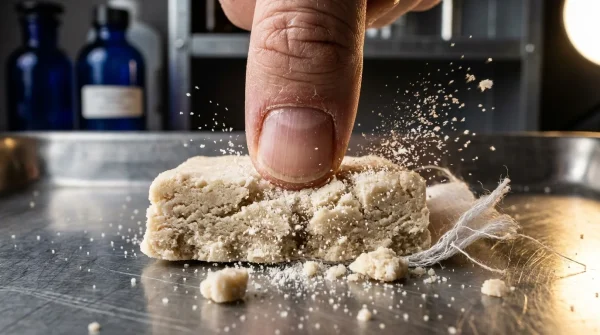
The grey light of 6:00 AM filters across your kitchen counter, catching the edge of a small ceramic jar. You press two fingers into the coarse, moist granules, lifting a jagged grey cluster onto the back of your tongue before reaching for a tall glass of filtered water. The internet promised this tiny daily sacrifice would awaken your cellular energy, light up your adrenals, and deliver mineral balance before the morning coffee even finishes dripping. It tastes like cold ocean stone, sharp and grounding.
Yet thirty minutes later, sitting at your desk, a curious and unpleasant drought settles across your mouth. Your lips feel unusually papery, and a sudden, rhythmic flutter in your left eyelid breaks your train of thought. You take another deep draft of plain water, expecting instant relief, but the tight, cottony feeling in your throat only deepens. Instead of boundless vitality, an odd hollow ache ripples through your lower abdomen, accompanied by a sudden faint twitch in your right calf muscle.
You did what every modern hydration guide told you to do: skip plain water, add raw electrolytes, protect your mineral baseline. So why is your body signaling distress as if you spent three days wandering through a salt pan without a canteen? The disconnect is not in your imagination; it is an unspoken physiological consequence playing out in millions of morning kitchens across the country.
The Cellular Siphon: How Solute Shock Stalls Intestinal Flow
To understand why a raw mineral pinch dries you out from the inside, you have to picture your intestinal lining not as a passive sponge, but as a heavily regulated border crossing. Water does not simply roll through your stomach wall into your bloodstream; it follows an uncompromising physical law called osmotic pressure. For water to move from your gut into your circulation, the fluid inside your intestines must have a lower concentration of dissolved particles than the blood flowing through the capillaries behind the intestinal wall.
When you drop dense, unrefined grey crystals directly onto a completely fasted digestive tract, you unleash an acute gastric solute saturation threshold event. The moisture in your mouth dissolves a portion of the sodium, magnesium, and trace chlorides, forming an intensely hypertonic slurry that lands in an empty stomach and rapidly dumps into the duodenum. There is no porridge, fiber, or protein to slow it down. The concentration of dissolved minerals inside the gut lumen instantly skyrockets past three hundred milliosmoles per kilogram, blowing past normal systemic balance.
Instead of absorbing the accompanying glass of water, your small intestine does the exact opposite: it panics. To protect its delicate epithelial surface from chemical burning and sheer osmotic irritation, your body pulls water out of your bloodstream and surrounding cellular tissues, dumping it directly into the intestinal cavity to dilute the mineral blast. You have not hydrated your cells; you have inadvertently created an internal siphon that drains fluid out of your peripheral nerves and capillary beds.
The Coach Who Watched High-Performing Stomachs Lock Up
Elena Vance, an endurance performance consultant based in Bend, Oregon, spends her days tuning the metabolic efficiency of competitive trail runners and executive athletes. In early 2023, she noticed a bizarre pattern in her client logs: seasoned athletes were reporting mid-morning brain fog, dry gums, and sudden muscle fasciculations before their workouts even began. Every single one of them had adopted the viral trend of placing moist raw sea salt directly under their tongues before drinking their morning water.
- Ergonomic neck collars alter cervical tilt sparking dull throbbing skull tension
- Maternity support bands compress lower ribcage margins sparking sudden desk suffocation
- Suboccipital base pressing drops surging pulse rates during solo panic episodes
- Braided leather wristbands ground runaway heartbeats through stealth tactile skin presses
- Toxic Waste candies trigger sudden salivary floods stopping runaway panic loops
Elena ran simple salivary and urine specific gravity tests across eight of her morning fasters and discovered what clinical gastroenterologists have recognized for decades. By dumping concentrated trace elements onto an empty stomach, these athletes were locking their enterocytes into an emergency osmotic hold. The gut was keeping all the ingested water parked in the digestive tract to dilute the salt shock, starving the rest of the body of fluid and triggering localized nervous system firing.
The Three Layers of Morning Mineral Disruption
The impact of this morning ritual is rarely identical for everyone. Depending on how your mornings unfold, the physiological stall manifests in distinct physical patterns across different daily routines.
1. The Fasted Solo Pinch
For the individual practicing intermittent fasting, the morning stomach contains only a minute pool of acidic gastric secretions and protective mucus. Introducing high-salinity crystals in this state creates an immediate paralyzing local osmotic gradient that arrests gastric emptying. The stomach hesitates to pass the aggressive brine forward, leaving you with an odd, heavy fluid sloshing in your upper belly while your mouth and throat dry out completely.
2. The Black Coffee Stacker
If you follow your mineral pinch with a steaming mug of black roast within fifteen minutes, you compound the osmotic siphon with rapid adenosine receptor blockade. Caffeine accelerates renal filtration while your intestines are still desperately hoarding water to buffer the salt shock. The result is an immediate spike in intracellular potassium loss, which appears physically as sharp involuntary flutters in the eyelid, thumb, or calf muscles.
3. The Under-Diluted Chugger
Many believe swallowing four to six ounces of water is sufficient to wash down a thumb-sized pinch of grey salt. In reality, that volume creates an intensely salty solution inside your stomach, requiring almost double that amount in systemic fluid extraction just to bring the mixture to an isotonic baseline. You feel an inexplicable fatigue wash over your shoulders within forty minutes as your vascular volume temporarily drops.
The Hydration Recalibration Protocol
You do not need to discard your mineral-rich unrefined salts; you simply need to honor the transport mechanics of the human enterocyte. Shifting from an aggressive mucosal shock to harmonious cellular uptake requires only a few deliberate micro-adjustments.
True cellular hydration occurs when sodium and water enter the small intestine at a balanced, near-isotonic ratio. When the mineral concentration matches biological fluid standards, sodium-glucose and sodium-potassium cotransporters whisk water across the intestinal membrane within minutes, flooding your cells rather than starving them.
- Dissolve, Never Drop: Never place dry, moist, or coarse mineral crystals directly onto your tongue or under your palate while in a fasted state.
- Respect the Osmotic Ratio: Dissolve no more than one-sixteenth of a teaspoon of unrefined salt per sixteen ounces of room-temperature spring or filtered water.
- Add a Kinetic Spark: Stir the water thoroughly until every microscopic speck is dissolved; visible grains at the bottom of the glass will trigger localized mucosal irritation.
- Temperature Alignment: Consume the mixture at lukewarm or room temperature (around seventy degrees Fahrenheit) to prevent gastric vascular constriction.
- The Buffer Window: Wait at least twenty minutes before introducing acidic beverages like espresso or black tea to let enterocyte fluid transit complete uninterrupted.
Your tactical toolkit is humble: a standard wooden measuring pinch spoon, a glass mason jar containing sixteen to twenty ounces of pure water, and sixty seconds of patient stirring until the water is completely clear.
Reclaiming the Logic of Real Thirst
Modern wellness culture frequently falls into the trap of believing that if a biological compound is beneficial, delivering it in an unbuffered, concentrated surge must be miraculous. We trade intuitive balance for extreme protocols, forgetting that nature never presents concentrated sodium without moisture, fiber, and biological context. Your digestive tract is a masterpiece of precision engineering designed to thrive on gentle, rhythmic equilibrium.
When you replace the shocking jolt of raw minerals with properly diluted, room-temperature hydration, the mysterious morning twitches fade into memory. Your lips remain soft, your saliva flows naturally, and the deep, clean energy you were searching for finally arrives without drama or physiological rebellion.
Real hydration is not an act of forcing minerals into your bloodstream; it is the art of preparing your gut lining to welcome water with absolute ease.
| Key Point | Detail | Added Value for the Reader |
|---|---|---|
| The Raw Salt Pinch | Hypertonic salt directly contact empty stomach lining. | Causes immediate reverse osmosis, pulling water from cells into gut. |
| Proper Dilution Ratio | 1/16 tsp fully dissolved in 16-20 oz room-temp water. | Creates near-isotonic state for rapid cellular uptake without cramps. |
| Nervous Twitch Origin | Sudden electrolyte disparity in peripheral capillary beds. | Explains eyelid flutters and calf spasms as fluid shifts, not deficiency. |
Frequently Asked Questions
Why do my lips feel chapped right after taking morning salt?
Direct salt pinches pull water out of oral mucosal tissues and circulation to balance the high mineral concentration, inducing rapid localized tissue dryness.Does Celtic salt have different absorption qualities than pink Himalayan salt?
While Celtic salt retains higher moisture and magnesium chloride content, any unbuffered raw sodium crystals will trigger osmotic solute shock on an empty stomach.Can I still use salt under my tongue if I feel lightheaded?
Sublingual absorption for true fainting episodes is a distinct emergency measure; routine morning fasting salt triggers gut-level fluid redirection that worsens chronic dehydration.How long after morning hydration should I wait before drinking coffee?
Allow fifteen to twenty minutes for your isotonic mineral water to pass through the pyloric sphincter and enter systemic circulation before introducing caffeinated diuretics.What is the quickest way to stop the morning muscle twitches?
Drink eight to twelve ounces of plain, lukewarm water to dilute the concentrated intestinal pool and restore normal fluid volume to peripheral nerve pathways.