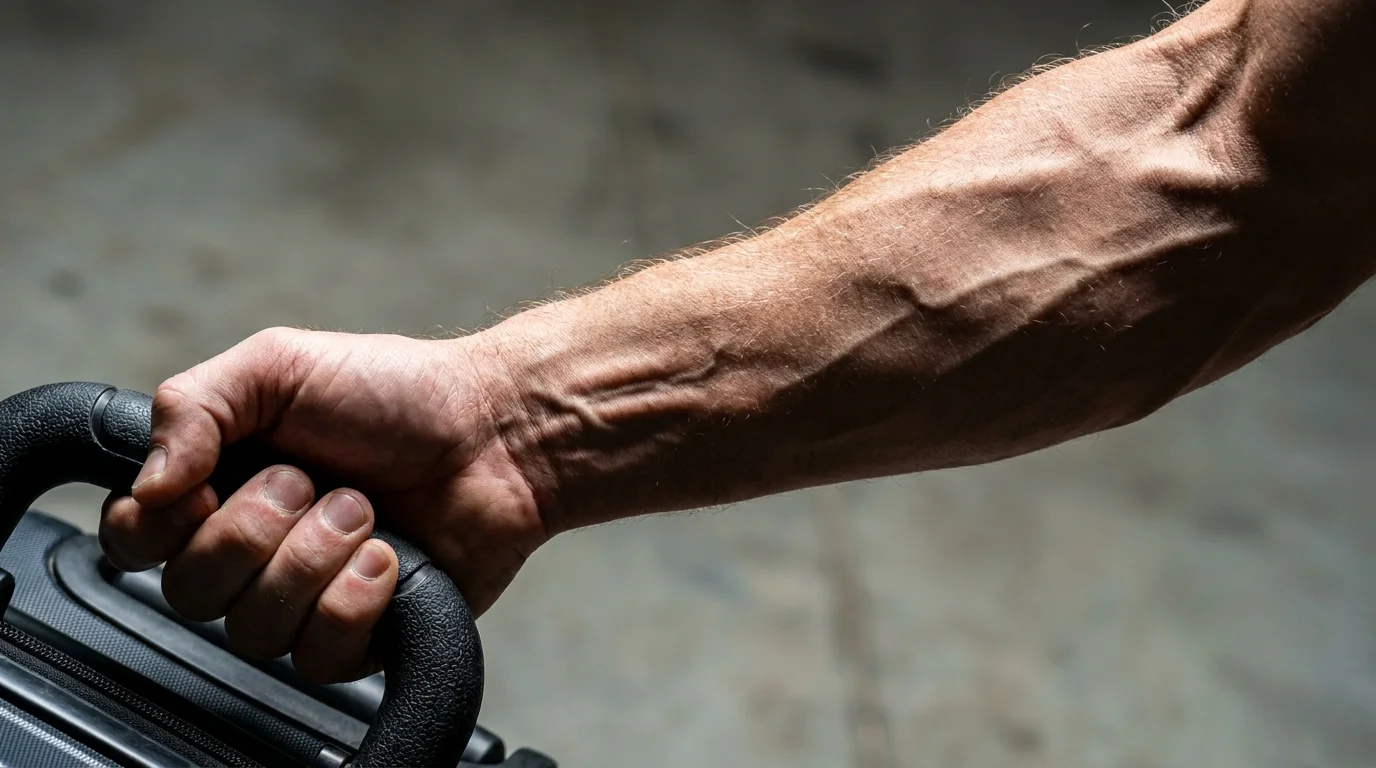
The metallic hum of the terminal walkway blends into the rhythm of thousands of travelers gliding effortlessly toward their gates. Under the harsh glare of industrial lighting, the soft scrape of polyurethane wheels rolling across polished airport terrazzo sounds almost peaceful. Your fingers loosely drape over a telescoping aluminum handle, the luggage drifting behind you like an obedient shadow while you balance a paper cup of dark roast in your free hand.
For decades, this frictionless motion has been sold as the pinnacle of ergonomic convenience. You assume that by rolling thirty pounds of clothing, shoes, and toiletries, you are saving your back from unnecessary ruin. Your body feels completely unburdened as you weave through the security lines, convinced that modern engineering has spared your joints the primitive indignity of heavy hauling.
Yet underneath that apparent ease, an unvoiced physiological trade-off is unfolding in real time. By eliminating the awkward, uneven demand of carrying a bag at your side, your forearm flexors, latissimus dorsi, and deep rotator cuff stabilizers have quietly clocked out, leaving your shoulder joint vulnerable to a creeping, silent weakness.
The Architecture of Unused Resistance
Consider the human shoulder not as a rigid ball-and-socket fixture, but as an architectural suspension bridge that relies entirely on taut cables. When you bear a load at your side with one hand, your body instantly awakens a chain of reflexive micro-adjustments. The rotator cuff fires to hold the arm bone snug in its shallow nest, while your opposite oblique muscles tighten to keep your spine tall and centered.
Wheeled luggage handles erase that entire structural conversation. By substituting a passive, low-friction rolling pull for an active muscular carry, the arm is held in an awkward, internally rotated dangle. Your wrist remains limp, the forearms slacken, and the delicate tendons that wrap your shoulder joint lose their primary stimulus for dense, functional integrity.
We often mistake comfort for joint preservation. When you remove the uneven struggle of a heavy suitcase, your body adapts to the lack of stress by letting connective tissues thin and muscle tone fade. Over months and years of business trips and holiday flights, this chronic lack of load turns resilient shoulders into stiff, fragile hinges that ache the moment you try to lift a heavy box into an attic or hoist a child into a swing.
The Cost of Frictionless Travel
Marcus Bennett, a 52-year-old architectural consultant based in Chicago, spent twenty years traveling through airport corridors with a top-of-the-line four-wheel spinner. He took pride in traveling light, gliding his sleek luggage effortlessly beside him while checking blueprints on his smartphone. But during an autumn site visit in Denver, Marcus reached into the passenger seat of his rental truck to grab a twenty-pound sample bag and felt a sudden, burning twinge bite deep into his right shoulder blade.
- Stomach sleeping angles lock lower lumbar joints sparking stiff morning back aches
- Yellow mustard spoonfuls shock racing nervous systems to halt sudden panic loops
- Refined soybean oil releases harsh stove smoke triggering sudden afternoon brain fog
- Triple-filtered tap water flushes natural mineral reserves sparking heavy midday fatigue
- Nature Valley bars trigger sudden sugar spikes and heavy midafternoon sluggishness during workdays
His physical therapist pointed past the acute reach and aimed directly at his pristine travel gear. Decades of pushing and trailing effortless wheels had stripped Marcus of his baseline grip power and dynamic stability. The cure was not expensive machines or surgery; it was learning how to carry things unevenly with intention once again.
Layering Strength Back Into Your Movement
Reclaiming that lost stability does not require ditching your rolling bag entirely. Instead, it calls for understanding your specific routine and reintroducing deliberate, loaded moments during your regular week.
For the Frequent Flyer
If you spend half your month traversing concourses, your challenge is intentional disruption. Rather than rolling your suitcase through the entire length of the terminal, convert the dead space between the boarding gate and the baggage claim into a temporary conditioning corridor.
Collapse the telescoping handle as soon as you step off the jet bridge. Carry the bag at your side by its reinforced fabric handle for two-minute intervals, alternating hands every fifty paces. This re-engages the grip reflex and pulls your upper trapezius into its natural stabilizing role without slowing your stride.
For the Daily Commuter
Many urban workers now drag rolling briefcases or heavy backpacks on tiny wheels down subway platforms. This habit frequently forces the walking shoulder into a fixed backward extension, pinching the neck and upper ribs over time.
Swap the drag for a physical suitcase carry whenever negotiating stairwells or flat open sidewalks. Holding twenty pounds firmly against your outer thigh recruits the deep core muscles, forcing your ribcage to stay stacked over your pelvis while building resilient grip tone in your fingers.
The Suitcase Carry Reclamation Protocol
You can rebuild the shoulder protection that rolling handles have quietly eroded by practicing a simple, unilateral suitcase carry drill right in your living room or garage. This drill conditions the rotator cuff to hug the shoulder socket tightly under tension while restoring forearm grip thickness.
Select a piece of luggage, a kettlebell, or a sturdy water jug weighing between fifteen and thirty pounds. Stand tall with your feet under your hips, pick up the weight in your dominant hand, and let your arm hang straight down against your outer leg.
- Draw your shoulder blades down toward your back pockets rather than shrugging them upward toward your ears.
- Keep your knuckles facing straight ahead, gripping the handle tightly enough to leave an impression in your palm.
- Maintain a two-inch gap between the weight and your thigh to prevent the load from resting against your leg as you walk.
- Walk smoothly in a straight line for forty paces, keeping your torso completely perpendicular to the floor without leaning sideways.
- Set the weight down gently, pause for thirty seconds, and repeat the sequence with the opposite arm for three total rounds.
Perform this routine three mornings a week. Focus on keeping your breathing steady and deep through your nose, using the tension of the grip to tether your upper back into absolute stillness.
• Target load: 20 to 35 pounds (or 15-20% of your body weight).
• Work duration: 45 seconds of continuous, upright walking per side.
• Rest period: 30 seconds between side transitions.
• Weekly frequency: 3 non-consecutive days.
Reclaiming the Dignity of Daily Load
Modern conveniences constantly tempt us to sand down the edges of everyday life until all resistance vanishes. We replace heavy shopping baskets with wheeled carts, wooden stairs with moving belts, and rugged duffel bags with four-wheel spinners that need only a single finger to steer. But human bone, muscle, and fascia are living materials that crave purposeful pressure to remain sturdy.
Every time you bypass the effortless wheel and pick up a dead weight with your bare hands, you remind your joints why they exist. The brief strain on your forearm and the firm clamp of your shoulder blade are not symptoms of hardship; they are the quiet, essential signals that keep you capable, grounded, and whole.
“Joints decay in the absence of work; true stability is earned each time your hand closes tightly around a heavy, uneven load.”
| Key Point | Detail | Added Value for the Reader |
|---|---|---|
| The Rolling Luggage Trap | Wheeled handles place the arm in continuous internal rotation with zero load. | Explains why frequent travelers experience unprovoked rotator cuff aches. |
| Unilateral Carry Deficit | Walking without side-loaded weight disables reflexive abdominal bracing. | Helps you identify how convenience creates subtle posture and core imbalances. |
| The Suitcase Carry Drill | A deliberate single-arm carry using 15-35 lbs across measured walking sets. | Restores raw grip strength and dynamically centers the humeral head. |
Frequently Asked Questions
Does this mean I should throw away my wheeled suitcase entirely?
Not at all. Wheeled bags are exceptionally helpful for navigating congested terminals quickly. The key is simply collapsing the handle occasionally to carry the bag manually for short distances, preserving your functional grip and shoulder stability.Why does carrying weight on only one side help my shoulder so much?
A unilateral load forces your nervous system to fire your rotator cuff and opposite side trunk muscles reflexively to keep you upright. This automatic stabilizing tension strengthens connective tissue far better than symmetrical machines can.What if my shoulder already clicks or pinches when I carry a heavy bag?
Start with a lighter weight, around ten to twelve pounds, and focus on keeping your shoulder packed downward rather than hunched forward. If sharp pain persists, consult a physical therapist before adding heavier travel loads.How quickly can I expect my grip tone and shoulder strength to return?
Most adults notice improved hand endurance and significantly less neck stiffness within three to four weeks of consistent, three-day-a-week suitcase carries.Can I just use wrist curls and standard gym machines instead?
While isolated forearm exercises build muscle size, they fail to train the simultaneous coordination between your grip, shoulder stabilizers, and walking gait that functional carries uniquely provide.