The motor hums with a quiet, polite whir as your standing desk riser lifts your monitor toward chest height. Sunlight glants across your clean keyboard, the morning coffee sits half-finished in its ceramic mug, and you feel a modest surge of virtue. You spent the last three hours anchored to your ergonomic task chair, knees bent at ninety degrees, grinding through spreadsheets and back-to-back video calls. Rising up felt like the responsible, body-conscious choice—an antidote to the modern seated slump.
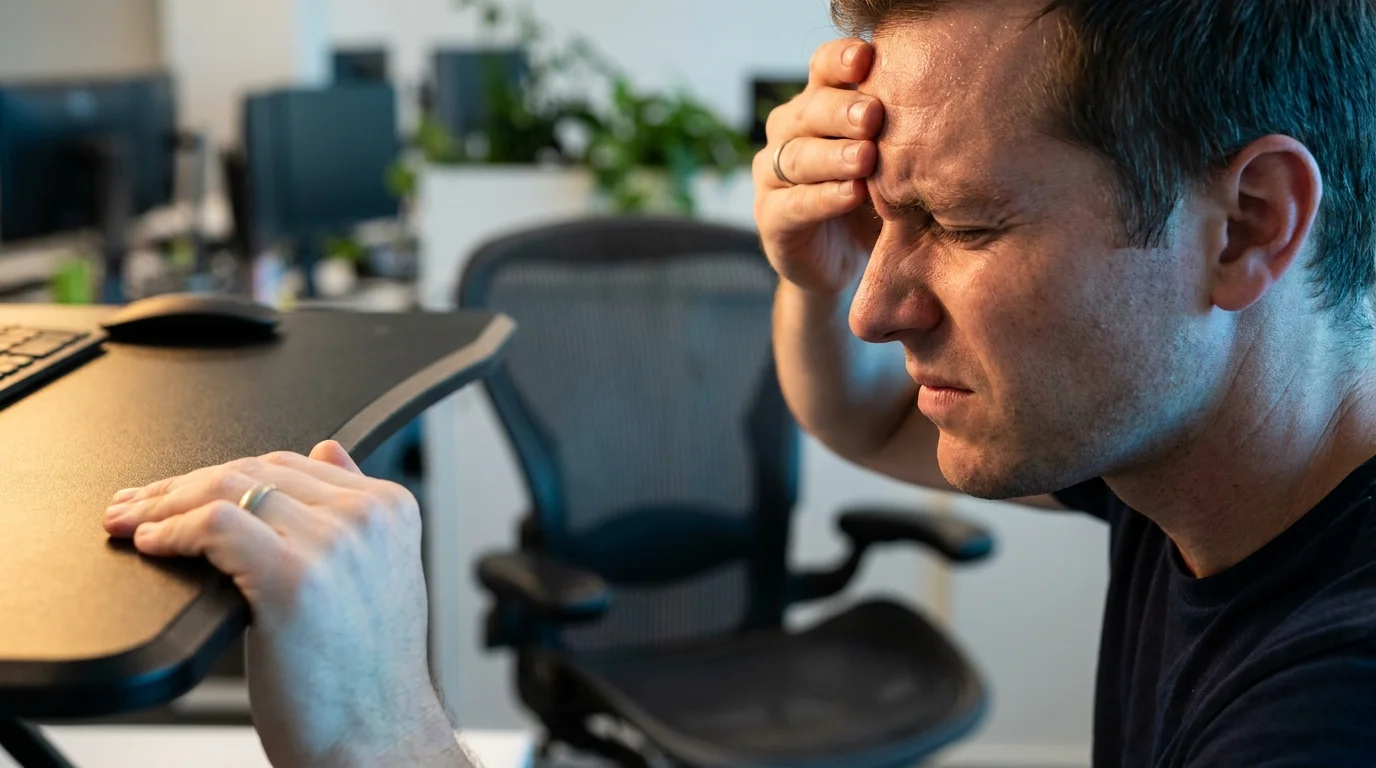
Then the floor seems to drift two inches to the left. Your vision bleaches out at the margins, shimmering into a pale static, while a curious, leaden heaviness washes through your quadriceps. Your palms instinctively grab the matte surface of the rising platform, fingers locking onto the bevel just to keep your balance upright. Your heart gives a sudden, frantic thump against your ribs, trying to catch up with an invisible drop in internal pressure.
You shake your head, blame your caffeine intake, or wonder if you forgot to drink enough water before noon. Yet the cold reality has nothing to do with dehydration or poor stamina. You just asked your vascular system to pull off an impossible mechanical pivot without giving the valves in your calves a fair warning.
The Siphon and the Sump: Why Gravity Traps Your Circulation
Consider your lower body like a deep water well governed by flexible hoses and sensitive pressure valves. When you sit folded into an office chair for several hours, your body settles into splanchnic and lower-limb pooling. Blood lazily gathers in the wide venous beds of your abdomen and the calf networks behind your knees. Your autonomic nervous system quietly dials back its vascular tone because resting in a bucket seat requires almost no mechanical counter-effort against gravity.
When you trigger your standing desk riser and spring straight up to meet it, you create an instantaneous siphon effect. Gravity pulls half a quart of blood downward into the veins of your legs before your arterial walls can stiffen in defense. Your baroreceptors—the microscopic pressure sensors resting inside your carotid arteries—sound an alarm that head-level blood pressure has plummeted. The brain dims the lights for three seconds to protect itself, leaving you trembling on rubbery knees while your heart races to refill the attic.
Marcus Vance, a forty-four-year-old architectural draftsman from Denver, knows that sickening sway intimately. After outfitting his home studio with a pneumatic riser to soothe an aching lumbar spine, Marcus found himself gripping the edges of his drafting table twice an afternoon, fighting off sudden dizzy spells that felt like step-downs in an elevator. It was only when an occupational physiologist pointed out that his rigid, locked-knee standing stance was effectively freezing his venous return pump that Marcus realized his pristine workspace setup was quietly starving his brain of oxygen.
- Freezing soak tubs lock post-workout joints into stiff next-morning grinding
- Plug-in wall warmers trigger dry throat tickles and afternoon voice cracking
- Sweat tent sessions trigger sudden dizzy spells and tight chest pressure
- Microcrystalline cellulose powders irritate digestive linings leaving stubborn chalky morning bloat
- Daily levothyroxine schedules clash with slow metabolic rates stalling steady weight loss
Calibration Layers: Dialing In Your Postural Transition
Not every body responds to vertical shifts in the same rhythmic beat. Understanding your personal vascular latency helps you adapt your setup rather than abandoning the upright posture altogether.
For the Focused Deep-Worker
If you lose track of time and stay pinned to your task chair for three or four hours without shifting, your vessels enter a semi-dormant state. Sudden vertical acceleration shocks your nervous system out of cold storage. You require a deliberate sixty-second physical warmup while still seated—pumping your ankles and squeezing your glutes—before you touch the riser button.
For the Barefoot Remote Worker
Working on hardwood, tile, or thin laminate without supportive footwear magnifies orthostatic pooling. Without an arch support or textured surface to stimulate plantar reflexes, your calf muscles stay slack even while standing. A simple wooden rocker bar or a dense anti-fatigue mat forces micro-contractions that drive blood upward continuously.
For the Post-Lunch Creator
After a midday meal, a substantial volume of your blood shifts toward your digestive tract to process nutrients. Transitioning directly from a low seated position to standing during this digestive window creates a double drain: the belly holds onto volume while gravity pulls the rest into your feet. Keep the desk low for at least forty minutes after eating before going vertical.
The Staged Elevation Protocol
Retraining your vessels does not require expensive balance boards or athletic conditioning. It requires giving your internal baroreceptors time to recalculate the column of fluid they are trying to support. Treat the act of standing up as a mindful, three-phase sequence rather than a single explosive movement.
- Engage the calf pump: While still seated, lift your heels twenty times firmly against the floorboard to prime the venous valves.
- The halfway perch: Raise the standing desk riser halfway first, shifting your weight onto your feet while resting your hips briefly against the chair edge.
- Soft-knee lock: When fully upright, maintain a micro-bend in both knees to keep your muscular walls pressurized around deep veins.
- The five-second gaze: Fix your eyesight on a stable, non-moving horizon point across the room rather than staring down at a moving computer screen.
Your tactical workspace toolkit requires only modest, precise additions. Set your riser motor to take at least eight seconds to reach full standing height rather than rapid-fire lifts. Keep an angled footrest under the workstation to allow alternating foot elevation every seven minutes. Most importantly, ensure the ambient room temperature sits between 68 and 71 degrees Fahrenheit, as warm room air causes peripheral veins to dilate and worsens fluid pooling.
The Ground Beneath Your Ambition
We often treat productivity tools as machines that should simply bend to our willpower. We buy motorized desks and expect our biology to snap into attention like flipping a toggle switch. But your circulatory system is an organic hydraulic network, intimately tuned to the rhythm of slow, deliberate movement.
When you learn to meet your riser halfway, the dizzying room spins vanish. You are no longer bracing against your workspace, white-knuckling the desktop laminate to keep the world upright. You find a stable, grounded equilibrium that supports your focus from the soles of your feet all the way to clear, unclouded thought.
The human heart is an extraordinary pump, but it relies on the quiet muscular rhythm of your calves to return the favor.
| Key Point | Detail | Added Value for the Reader |
|---|---|---|
| Venous Stasis | Three hours of sitting allows blood to collect in abdominal and calf beds. | Explains why lightheadedness is vascular, not a sign of poor physical fitness. |
| Baroreceptor Lag | Pressure sensors in your neck need 8 to 15 seconds to adjust arterial tone. | Prevents panic during the initial five seconds of standing upright. |
| Staged Elevation | Pausing halfway and flexing ankles primes the muscular pump. | Eliminates room spins without interrupting your daily work focus. |
Frequently Asked Questions
Why do my knees feel weak and trembling right after I raise my desk?
When blood pools in your lower limbs, your quadriceps and stabilizer muscles experience a brief, temporary dip in oxygenated blood flow, producing that sudden sensation of rubbery weakness.Does drinking more cold water stop these standing dizzy spells?
While hydration supports general blood volume, it cannot overcome the mechanical downward pull of gravity if your calf muscles remain slack and your knees stay locked.How long should I wait before transitioning to standing after lunch?
Give your digestive system roughly thirty to forty minutes of seated time after a balanced meal to prevent digestive blood pooling from competing with your upright circulation.Are balance boards helpful for preventing orthostatic wobbles?
A simple contoured mat or rocking bar is generally safer during the initial transition; unstable balance boards can worsen disorientation if your baroreceptors are already lagging.When should I consult a doctor about standing dizziness?
If the room spins persist for more than thirty seconds after rising, or if you experience chest pain, blackouts, or cold sweats, consult a healthcare professional to rule out autonomic issues.