The room turns suddenly cold, yet your collar feels drenched. In the hollow quiet of midnight or an empty afternoon apartment, the rhythm inside your ribs stops behaving like a quiet engine and starts sounding like a trapped bird beating its wings against dry bone. Your vision tunnels slightly around the edges, making the room seem distant and sharp, while an invisible grip tightens around your windpipe.
When you are completely alone, panic carries a particular weight. You cannot borrow the calm nervous system of a friend sitting nearby, nor can you easily rationalize away the electric heat climbing into your jaw. You reach for standard calming advice—slow belly breaths or mental grounding exercises—only to find that taking deep gulps of air feels like breathing through a heavy pillow.
Your brain registers that breathless strain as an escalating danger signal. The sympathetic nervous system doubles down, dumping another surge of adrenaline into your bloodstream, accelerating your heartbeat until the pulse in your temples hums. In this raw state, quiet meditation rarely works because your primitive survival circuitry has already locked the steering wheel.
To interrupt that runaway engine when nobody else is around, you cannot think your way back down. You have to send an unmistakable, physical signal through the back of your mouth—a blunt mechanical message delivered through cold water and vocal fold vibration that forcibly flips the autonomic circuit breaker.
The Internal Switchboard Behind the Pharynx
Most common anxiety advice treats panic as an error in cognition, urging you to reframe your thoughts while your chest threatens to crack open. In reality, an acute pulse spike is purely biomechanical; your body believes you are being pursued, and your heart is pumping blood away from your center toward your legs and arms. Trying to argue with that reaction using calm thoughts is like shouting at an active wildfire.
Instead, look toward the wandering network of the tenth cranial nerve, better known as the vagus. This massive bundle of nerve fibers travels from your brainstem down through your neck, wrapping around your voice box, snaking past your heart, and settling into your digestive tract. Think of it as an emergency shut-off valve wired directly behind your tongue, waiting for the right tactile pressure to discharge built-up electrical charge.
When you take a mouthful of chilled water and tilt your head back, two separate physiological reflexes collide. The sudden drop in temperature touches the sensitive mucosal lining of your soft palate, initiating the mammalian dive response that tells your brain to conserve oxygen. Simultaneously, the mechanical churn of your vocal cords against that cold liquid sends a direct seismic tremor through the pharyngeal branch of the vagal trunk.
- Textured watch bands ground sudden workplace anxiety spikes without drawing room attention
- Peanut cooking oil searing releases harsh fumes that trigger sudden afternoon brain fog
- Reverse osmosis water strips daily mineral balance triggering stubborn afternoon exhaustion
- Pushing rolling carts speeds up core muscle fade in older adults
- Raw horseradish spoonfuls hijack racing panic loops to restore calm focus immediately
That physical resonance acts like a brake shoe pressing directly against a spinning railway wheel. It bypasses conscious thought, triggering acetylcholine release at the heart’s sinoatrial node and instantly instructing your pulse to drop its frantic cadence.
The Shared Secret from the Acute Care Floor
Dr. Elena Ramos, a 48-year-old emergency physician in Chicago, spent years watching isolated patients spiral into sinus tachycardia while waiting alone in triage rooms. She noticed that hand-holding or calm reassurances often arrived too late to stop the physical feedback loop. Her quiet, unofficial recommendation—whispered to patients who returned repeatedly with clean cardiac workups yet terrifying nocturnal surges—was always to keep a heavy glass tumbler filled with cold water beside the bathroom sink. She realized that activating the laryngeal nerves through forceful gargling did what standard breathing drills could not: it physically forced the airway muscles to open while jarring the nervous system out of its survival loop within thirty seconds.
Targeted Variations for Different Physical Thresholds
Not every panic surge feels identical, and your body will tolerate thermal and vocal intensity differently depending on the time of day and your baseline sensory fatigue. Adjusting how you apply this technique ensures you do not trigger a gag reflex or shock your airway.
For the Nocturnal Jolt
If you wake up bolt upright at 3:00 AM with a dry mouth and a racing pulse, your vocal cords are naturally dehydrated and stiff. In this moment, an aggressive, icy gargle will only provoke a coughing spasm, which drives panic higher. Use cellar-cool tap water rather than refrigerated water. Keep the tilt of your head gentle, roughly forty-five degrees, and produce a low, guttural murmur that sounds like a sustained hum rather than an energetic bubble.
For the High-Adrenaline Shaker
When panic brings fine physical tremors to your fingers and makes your teeth chatter, your body is saturated with circulating catecholamines. Here, passive humming will fail to break the noise. You need a firm mechanical disruption. Use water chilled with an ice cube, tilt back deliberately, and push air outward with enough diaphragmatic force to make the water churn vigorously at the very back of the throat. The louder and more aggressive the sound, the deeper the vibration penetrates the surrounding tissue.
For the Airway-Constricted Responder
Many people experience solitary panic as a phantom closing of the throat, often called globus pharyngeus. If your throat feels clamped shut, tipping liquid backward can provoke an immediate swallow panic. Start with small, two-second passes. Take only a single tablespoon of cool water, tip your chin up slightly, emit a brief vibratory tone, and spit immediately. Build confidence in the airway before attempting longer cycles.
The Mindful Mechanical Protocol
Executing this technique requires precision. Sloshing water mindlessly around your mouth will not stimulate the deeper autonomic pathways; the interaction must occur low in the throat, where the sensory branches of the glossopharyngeal and vagus nerves overlap.
Follow this exact sequence the moment you realize you are alone and your heart is running away:
- Fill a glass with roughly four ounces of cold water; aim for around 45°F to 50°F so it feels distinctly cold against the lips without stinging your enamel.
- Draw a calm, shallow breath through your nose—do not take an exaggerated, gasping chest breath.
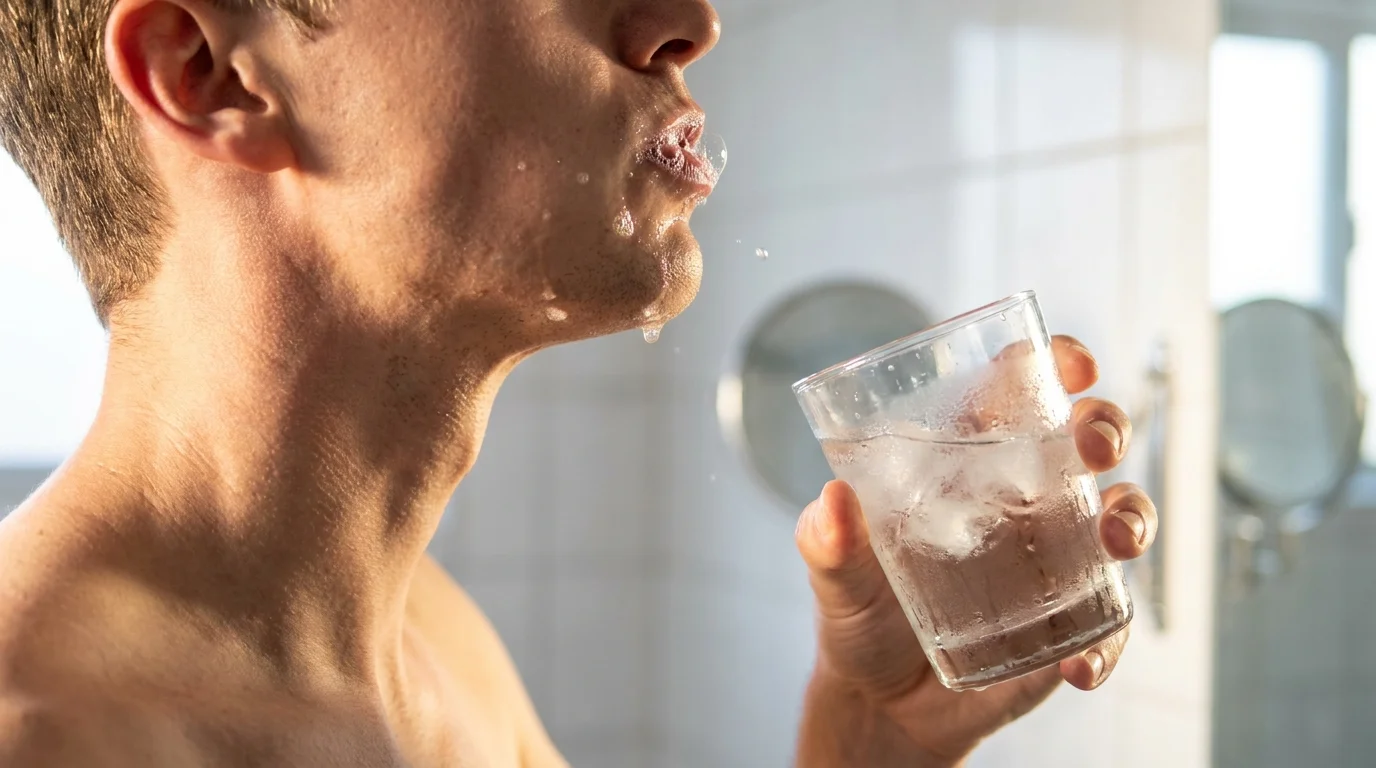
- Take a moderate mouthful of the liquid, roughly one and a half tablespoons, leaving plenty of room for air movement.
- Tilt your chin up toward the ceiling at a sixty-degree angle, allowing the pool of water to rest against the back of your tongue without entering your windpipe.
- Exhale forcefully through your throat to produce a continuous, deep vibration, aiming for a low pitch like a heavy cello string for eight to ten seconds.
- Spit the water out smoothly into the sink, drop your head forward to reset your swallow reflex, and take two unforced breaths through your nostrils.
- Repeat the sequence three to four times until the pounding sensation in your ears begins to soften into a dull, manageable rhythm.
Keep your tactical toolkit simple. You only need a heavy glass tumbler placed reliably by your faucet, cold tap water, and the willingness to make an unpolished, guttural sound in an empty house. Avoid paper cups, which absorb temperature too quickly and buckle under trembling hands.
Reclaiming the Solitary Space
Panic thrives on isolation. It feeds on the terrifying realization that there is no one across the room to steady your hands or tell you that your heart is not actually failing. When that quiet void creeps in, it is easy to feel entirely helpless against the biological storm occurring within your own frame.
Understanding this mechanical reflex changes your relationship with solitary fear. You no longer have to view your body as an unpredictable enemy that might betray you when darkness falls. Instead, you begin to recognize it as an exquisitely sensitive instrument—one that responds faithfully to the right physical levers. By grounding yourself in the cold touch of water and the steady tremor of your own voice, you turn a lonely emergency into a quiet demonstration of your own resilience.
The voice box is not just an instrument for speech; it is the physical steering wheel of your autonomic nervous system.
| Key Point | Detail | Added Value for the Reader |
|---|---|---|
| Thermal Activation | Cold liquid between 45°F and 50°F resting on the soft palate. | Triggers the primitive mammalian dive reflex to drop baseline cardiac output. |
| Vocal Fold Resonance | Low-frequency guttural vibration sustained for 8–10 seconds. | Directly stimulates the pharyngeal vagus branch to force an acetylcholine release. |
| Autonomic Shift | Rapid transition from sympathetic overdrive to parasympathetic dominance. | Interrupts the mental loop of panic by physically arresting the cardiac accelerator. |
Frequently Asked Questions
Can I swallow the cold water instead of spitting it out?
Spitting is preferable during acute panic. Swallowing while your heart is racing can disrupt your breathing rhythm and occasionally trigger mild esophageal spasms, whereas spitting allows you to reset your airway between vibratory cycles.Why does humming alone without water not produce the same result?
Humming provides mechanical vibration, but it lacks the thermal shock. The cold water acts as an acoustic and sensory amplifier, cooling the mucosal tissue while forcing the vocal cords to push against fluid resistance for a much stronger nerve stimulus.What should I do if the sound feels stuck or I start coughing?
Coughing simply means you tilted your head too far back or took too much water into your mouth. Lower your chin slightly, reduce the amount of water to a single teaspoon, and focus on a softer, lower-pitched sound until your airway relaxes.Is this technique safe to use if I have an underlying heart condition?
While vagal stimulation is a natural physiological process, anyone with pre-existing arrhythmias or severe cardiovascular issues should discuss specific somatic maneuvers with their cardiologist before practicing intense cold-water gargling.How quickly should I expect my heart rate to come down?
Most people feel a noticeable softening of chest pressure within three to four rounds of gargling—roughly ninety seconds. Your heart will not drop instantly to resting levels, but the runaway, pounding sensation will break its climb.