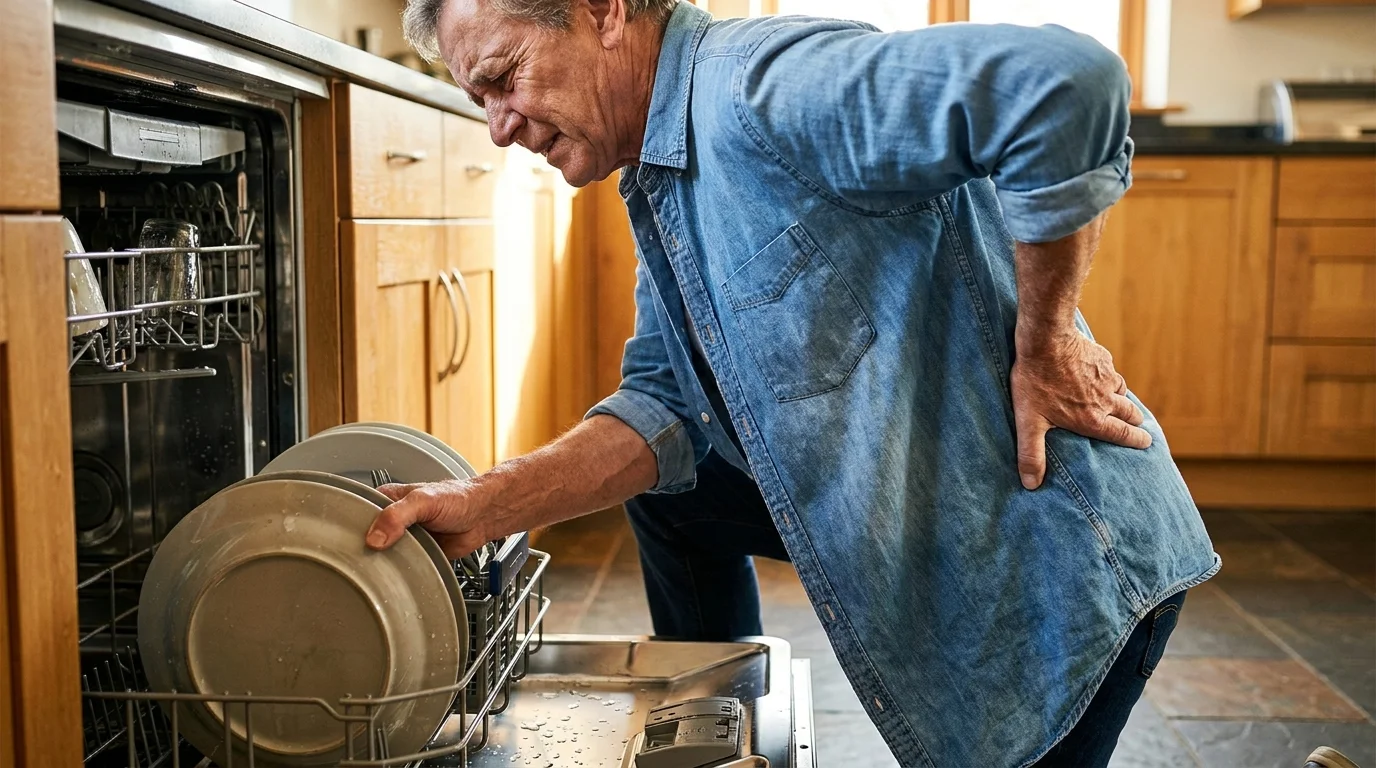
The steam escapes with a faint, metallic hiss the moment you unlatch the front door. There is that familiar scent of dried citrus detergent and heated porcelain drifting across the cool morning floor tiles. You grab the first coffee mug, slide out the bottom rack on its tiny plastic wheels, and tilt forward to lift a heavy cast-iron skillet.
Then the warning flash hits. It is not an explosive snap, but a dull, hollow pull that burrows directly into the crest of your left pelvic bone before radiating across your lower lumbar spine. You straighten up slowly, resting a damp palm against the edge of the granite counter, wondering when a trivial household errand began feeling like hoisting sacks of grain.
Most people brush off this sudden morning stiffness as a vague token of getting older. You assume your spine is simply registering miles, or perhaps that you slept on a worn mattress. Yet the true culprit rarely lives in your bed or your general fitness level. Instead, the friction starts in the repetitive, three-dimensional torque required by the lowest wire basket in your kitchen.
When you stand square-toed against the baseboard and reach down into a cavernous cavity, you are not simply bending over. You are forcing your hips to lock in a compromised angle while your spine acts as an unbraced cantilever. For cartilage that has supported you through decades of walking, climbing, and lifting, this daily chore creates a silent wear pattern that grinds away joint comfort.
The Rotational Fulcrum: How Low Racks Trap the Hip Joint
Think of your hip socket like a precision ball bearing bathed in smooth fluid. When you hinge squarely from the center of that bearing, force disperses across thick bands of fascia and large gluteal muscle fibers. But the modern domestic machine does not invite square hinges. It forces a diagonal twist.
Consider what unloading actually looks like. Your feet remain parked in front of the open drop-door, your torso dives forward twenty inches, and your ribcage spins to transfer a stack of ceramic bowls up to a cabinet overhead. This combination of flexion and rotation turns your lumbar vertebrae into a torsion bar, forcing the lower spinal discs to stabilize a load that your hips surrendered the moment you twisted.
As we cross our late forties and fifties, the natural cushion inside the acetabular labrum—the soft rubbery seal keeping your hip stable—naturally thins. It loses water content, behaving less like fresh silicone and more like hardened rubber. When you combine deep bending with lateral twisting, the head of the thigh bone pinches against the rim of the socket, transferring that unabsorbed shock directly into the sacroiliac joint.
- Premier Protein shakes trigger sudden afternoon cravings behind hidden artificial sweetener blends
- Pretending constant agreement fuels chronic nervous fatigue and ruins restful nighttime sleep
- Shoulder blade pressing releases stubborn knot tension across stiff desk-bound shoulders
- FDA Inluriyo approvals shift advanced breast cancer treatment protocols across oncology clinics
- Meningitis symptom surges prompt urgent emergency room visits across multiple states
The Lesson from the Recovery Clinic
Dr. Paul Callahan, a physical rehabilitation specialist based in Flagstaff, spent years treating mature trail runners and gardeners whose back pain flared exclusively on Sunday mornings. For months, his patients blamed uneven cobblestones or spade work, unaware that their daily dish cycle was quietly undoing their clinical progress.
One of his long-term patients, a 58-year-old high school librarian named Elena, presented with persistent sciatic tightness that vanished on holidays but spiked by Tuesday morning. After auditing her routine down to the inch, Dr. Callahan discovered she was clearing three full loads of ceramic dishes every weekend while keeping her knees completely locked and pivoting on a glued left heel.
By shifting Elena’s base of support by just ten inches—converting a rigid bend into a floating counterbalance—her lingering sciatic ache cleared within nine days. It was not a matter of core weakness or failing discs. It was simply that her skeleton was fighting against basic mechanical leverage inside her own kitchen.
Tailoring Your Movement: Three Kitchen Scenarios
Every home demands a slightly different spatial compromise. Recognizing how your physical floorplan amplifies joint torque allows you to dismantle the stress before bending down.
For the Galley Kitchen Navigator
In narrow walkways, there is rarely room to drop your torso straight forward without bumping your hips against the opposing cabinets. You end up bending sideways, curving your spine like a fishing rod while reaching into the bottom rack. In this tight footprint, keep your hips parallel to the open door and pivot your entire body as a single unit rather than spinning your shoulders across your pelvis.
For the Heavy Cookware Enthusiast
Casserole dishes, stone bakeware, and enameled Dutch ovens present an aggressive leverage challenge. Pulling an eight-pound pot from floor level while your torso is pitched forward generates nearly seventy pounds of shear pressure across the L4-L5 vertebrae. For these dense loads, never lift directly from the rack to the shelf; instead, stage heavy pieces onto the counter edge first to reset your spinal alignment.
For the Morning Coffee Multitasker
Rushing through unloading while waiting for the kettle to boil means cold muscles are subjected to sudden torsional strain. Connective tissue is naturally dehydrated after hours in bed. If you must clear the washer before your first cup, commit to thirty seconds of ankle circles and standing knee raises to warm the joint capsule before bending.
Mindful Application: The Kickstand Stance Reset
Protecting vulnerable hip cartilage does not require purchasing an elevated commercial washer or hiring domestic help. It relies on a single mechanical adjustment: the split-stance kickstand.
By sliding one foot slightly backward and bearing your bodyweight through the front heel, you unlock the hip socket and let the large gluteal muscles take the load off your lower back.
- Stand perpendicular to the open machine door rather than facing it directly, positioning your dominant foot four to six inches back.
- Elevate the heel of that rear foot slightly, treating it like a kickstand on a bicycle to eliminate rigid pelvic locking.
- Hinge your torso forward exclusively through the front hip crease, maintaining a straight line from your ear down through your tailbone.
- Rest one forearm on the edge of the countertop or your front thigh to transfer upper-body weight away from your lumbar spine.
- Retrieve dishes in small clusters and gather them on the middle counter before standing completely tall to restack high shelves.
Adopt this stance consistently for forty-eight hours. You will notice that the grinding, pinched sensation in the front of your groin evaporates, leaving your lower spine supple, stable, and completely quiet throughout your morning chores.
The Tactical Kitchen Toolkit
Fine-tune your environment with these exact physical benchmarks to keep routine movement effortless:
- Rack Clearance Angle: Keep your front knee bent at approximately 20 degrees during low rack retrieval to engage the hamstring instead of the lower back.
- Counter Staging Height: Keep drop-off zones between 34 and 36 inches high to avoid overhead reaching while your body remains bent.
- Pacing Interval: Unload the bottom rack in two distinct halves, pausing for three full breaths in an upright, neutral posture between batches.
The Bigger Picture: Reclaiming Everyday Movement
It is easy to surrender small corners of our physical comfort to the narrative of aging. We assume that stiff mornings, tender lower backs, and aching hips are simply the price of decades lived. Yet our bodies are remarkably forgiving when we respect their architectural rules.
When you transform a mindless chore like clearing dishes into a deliberate, supportive movement pattern, you do more than save your hip cartilage from premature wear. You cultivate an enduring physical intelligence that carries over into how you lift a bag of soil, carry a grandchild, or step out of the car. Vitality rarely hinges on monumental gym sessions; it lives in how gently you navigate home.
Good biomechanics is not an athletic luxury; it is the quiet courtesy your spine deserves during the smallest domestic routines.
| Key Point | Detail | Added Value for the Reader |
|---|---|---|
| The Rotational Trap | Twisting the ribcage while feet remain stationary during low reaches. | Removes hidden disc shearing forces. |
| The Kickstand Stance | Staggering feet by 6 inches with the rear heel slightly elevated. | Directs heavy lifting stress into strong glutes. |
| Countertop Staging | Resting items at waist height before putting them into high cabinets. | Eliminates dangerous full-spine flexion-extension whips. |
| Cartilage Protection | Softening knees to 20 degrees during deep compartment retrievals. | Preserves thinning labrum tissue in mature hips. |
Frequently Asked Questions
Why does my back hurt worse unloading the dishwasher than loading it?
Loading involves handling light, single items one by one. Unloading often tempts you to lift heavy stacks of plates or nested cookware from the lowest wire tray in a single, rushed pull, which rapidly overloads cold lumbar stabilizers.Should I squat down completely to reach the bottom rack?
A deep squat can pinch mature knee joints and tight ankles. The split-stance kickstand hinge is far safer because it distributes weight through your front glute while keeping your shins mostly vertical.Is an elevated dishwasher drawer worth the home renovation?
If you suffer from chronic lumbar disc herniations or severe hip osteoarthritis, elevating your machine 12 to 18 inches off the ground dramatically reduces bending cycles and provides immediate physical relief.Can tight hamstrings cause this specific chore-related pain?
Yes. When your hamstrings are stiff, they anchor your pelvis in a backward tilt, forcing your lower lumbar spine to curve excessively to reach deep corners.How quickly does hip irritation calm down after changing stance?
Most people experience a noticeable drop in morning stiffness within three to five days once the repetitive micro-pinching across the joint labrum stops.