The kitchen is still blue with dawn when you hear the quiet hiss of your drip coffee maker. The room smells of dark roast, familiar and warm, promising to break the stubborn film behind your eyes. Yet forty minutes later, after draining a steaming ceramic mug on an empty stomach, that familiar, brittle sensation takes over: your heart ticks slightly faster against your ribs, your palms feel clammy, and your thoughts dart around like scattered dry leaves without ever settling into deep clarity.
You are likely confusing sudden central nervous stimulation with actual mental presence. When you wrench yourself awake with black coffee, you flood tired adrenal pathways with synthetic urgency, burning through early glucose reserves before your feet have even warmed against the hardwood floor.
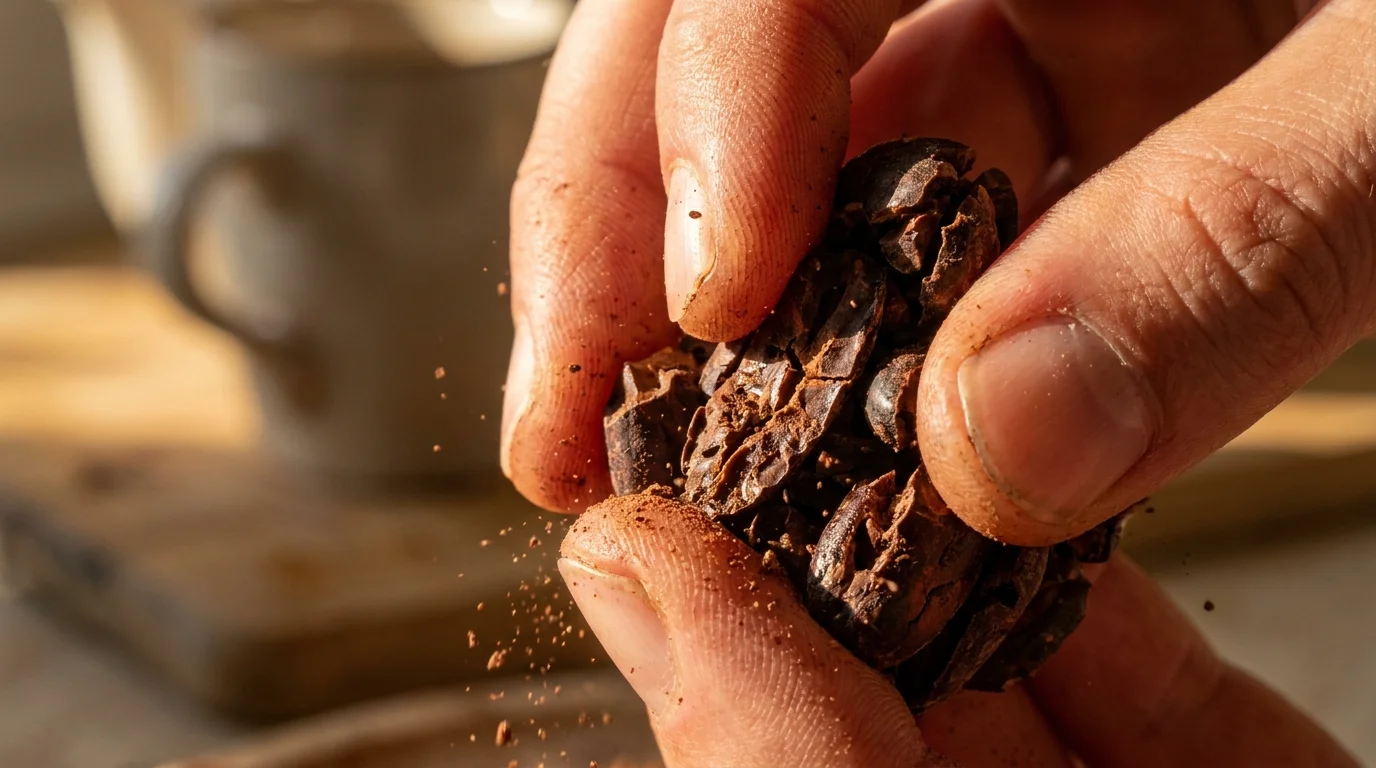
There is a different sensation waiting in the quiet dark of your pantry. It lives inside a simple bag of raw cacao nibs—unprocessed, jagged little wood-colored shards that shatter between your molars like toasted woodsmoke. They taste fiercely bitter, earthly, and almost shockingly austere. There is no velvet sweetness, no milk fat, no gentle confectionery disguise.
That biting, unapologetic crunch triggers an immediate, involuntary shift. The bitter notes hit the lingual receptors on the back of your tongue, jolting your cranial nerves awake while a steady wave of theobromine gently coaxes your cerebral arteries open. Within minutes, the heavy morning wool behind your temples recedes, leaving behind a sustained, calm wakefulness that black coffee routinely promises but rarely delivers.
The Vascular Current: Why Gentle Dilatation Beats Adrenal Shock
To understand why this rustic kitchen staple clears morning grogginess so decisively, you have to picture your circulatory system not as a pump that needs to be whipped, but as a riverbed that needs space to flow. Standard morning caffeine acts like a cattle prod on your heart muscle. It forces your system into an artificial survival sprint, constricting peripheral blood vessels while spiking systemic cortisol.
Raw cacao works on an entirely opposite physiological principle. Rather than leaning on raw caffeine, unprocessed cacao beans carry a dense concentration of theobromine alongside potent flavanols that stimulate local endothelial nitric oxide production. Instead of pinching your blood vessels tight, it softly widens them. Blood volume quietly glides straight into the micro-capillaries of your prefrontal cortex, clearing away nighttime metabolic debris without demanding a single erratic beat from your heart.
- Rotisserie chicken meals paired with antacids spark painful upper belly pressure
- Bottled coconut water triggers sudden postural room spins and trembling leg weakness
- Hard peppermint candies spark stubborn afternoon jaw tension and shooting temple aches
- Post-lift cold showers lock in stubborn next-morning joint stiffness and muscle aches
- Chamomile sleep tinctures spark sudden 3 AM awakenings with racing heart rates
Then comes the neurochemical gift of anandamide—often called the bliss molecule—and natural magnesium. While coffee borrows tomorrow’s energy today by masking your brain’s adenosine receptors, raw cacao nibs feed your synapses the cellular minerals required to maintain mental stamina. You do not feel the familiar, jittery edge of a caffeine spike; instead, your vision simply clears, much like someone wiping steam off a bathroom mirror with a dry linen towel.
Dr. Elena Rostova, a 46-year-old integrative neurologist based in Portland, Oregon, spent years watching desk-bound executives complain of 10:00 AM mental stalls despite drinking three morning pour-overs. During a clinical field study on plant alkaloids, she shifted a small cohort of chronic fatigue patients off early-morning black roast and instructed them to chew five grams of raw Venezuelan criollo nibs alongside two glasses of tepid water. Within ten days, over eighty percent of the cohort reported the complete disappearance of the mid-morning brain fog, describing their attention span as calm, anchored, and remarkably immune to midday sugar cravings.
Tailoring Your Chew: Three Morning Adaptation Protocols
Not everyone wakes with the same metabolic speed or gut sensitivity. How you introduce these bitter fragments determines whether they feel like an abrasive medicinal chore or a revitalizing morning anchor.
For the Fasting Purist
If you prefer to keep your digestive tract resting until noon, you want zero caloric interference. Measure out roughly one level teaspoon (about four to five grams) of raw, unsweetened cacao nibs. Do not grind them into a powder or toss them back with water like pills. The secret lies in mechanical mastication: chew them slowly with your back molars for at least thirty seconds. Letting the bitter astringency coat your palate triggers the gustatory-vagal reflex, signaling your liver to release early digestive enzymes while your brain registers clean alertness without breaking your metabolic fast.
For the Sensitive Stomach
Some stomachs curl at intense bitterness first thing in the morning. If your digestion tends toward hyperacidity or morning nausea, fold half a tablespoon of raw cacao nibs into two spoonfuls of full-fat unsweetened coconut yogurt or a tiny smear of warm almond butter. The rich plant lipids coat the stomach lining, softening the tannins while allowing the theobromine to absorb slowly through the intestinal walls over the course of three hours.
For the Rushed Desk Worker
When you have seven minutes before an early client call and your brain feels like wet dough, pair your cacao nibs with sea salt and hydration. Place a pinch of coarse pink Himalayan salt on your tongue, drink eight ounces of room-temperature water, and immediately chew a tablespoon of raw nibs. The sodium-potassium balance accelerates cellular hydration while the cacao flavanols increase cerebral micro-circulation before you even open your laptop.
The Five-Minute Kitchen Method: Your Daily Awakening Sequence
Executing this morning switch requires no specialized machines, paper filters, or twenty-minute waiting periods. Keep your jar of cacao nibs right next to your water kettle as a visible cue.
- Hydrate first: Pour ten ounces of lukewarm water with a tiny squeeze of lemon. Drink it entirely before touching the jar.
- Portion precisely: Scoop out six grams—roughly one rounded teaspoon—of whole, single-origin raw cacao nibs into your palm.
- Chew deliberately: Place them on your tongue. Chew slowly, deliberately breaking the dense nibs into fine particles over forty seconds before swallowing.
- Follow with warmth: Sip a mug of hot plain water or mild chamomile tea to dissolve any lingering botanical oils across your palate.
The Tactical Toolkit
Dose: 5 to 7 grams (1 rounded teaspoon)
Timing: Within 10 minutes of waking, before any solid breakfast
Texture Target: Whole unroasted nibs, strictly raw, single-origin (Criollo or Trinitario varieties work best)
Temperature Pairing: Room-temperature water (68°F to 72°F) to prevent stomach contraction
The Bigger Picture: Reclaiming Mental Quiet
We have conditioned ourselves to believe that alertness must feel violent to be real. Modern work culture celebrates the dark, scorching cup that makes your pulse skip, equating agitation with productivity. But that trembling energy is often just an unspoken form of physical panic, masking an exhausted mind that simply wants oxygen and steady nourishment.
Stepping away from the steaming coffee pot toward the quiet, woodsy crunch of a raw cacao bean is more than a nutritional swap. It is an agreement to treat your nervous system with patience. When you give your brain expanded blood flow and stable mineral support instead of a sudden adrenal punch, morning fog stops feeling like an enemy you must conquer with adrenaline. It dissolves naturally, leaving you calm, lucid, and entirely in command of your day.
“When we stop shocking the brain with chemical alarms and start opening its vascular pathways, true focus arrives without the tax of anxiety.”
| Key Point | Detail | Added Value for the Reader |
|---|---|---|
| Primary Active Compound | Theobromine (approx. 200mg per 10g cacao) vs. sharp caffeine in coffee | Gentle, longer-lasting cerebral blood flow without jittery muscle tension |
| Cardiovascular Action | Promotes peripheral vasodilation via local nitric oxide release | Lowers heart strain upon waking while increasing oxygen delivery to frontal lobes |
| Digestive Impact | Natural polyphenol astringency triggers healthy gut and liver tone | Prevents acid rebound and midday stomach cramping common with black roast |
Frequently Asked Questions
Will chewing raw cacao nibs keep me from drinking my regular coffee later?
Not necessarily, but you will likely find you need far less. Chewing your cacao nibs upon waking clears the heavy initial fog; if you still enjoy the aroma and social comfort of a coffee, enjoy a smaller cup around 10:00 AM when your natural cortisol rhythm naturally begins to dip.Why can’t I just eat dark chocolate instead?
Commercial dark chocolate, even at eighty percent, contains added sugar, soy lecithin, and cocoa butter processed with heat, which dulls the active theobromine concentration and introduces simple sugars that trigger an early insulin spike.How bitter are raw cacao nibs to the unaccustomed palate?
They taste like the darkest roasted coffee bean blended with dry earth and walnuts. While the first bite can surprise you, your palate adapts within three to four days, and you will quickly begin craving the clean, grounded sensation they leave behind.Can raw cacao nibs cause heart palpitations?
Because theobromine is a far weaker cardiac stimulant than caffeine, palpitations are extremely rare at the recommended 5-to-7-gram serving. However, if you have a diagnosed sensitivity to theobromine, start with just half a teaspoon to assess your body’s response.How should I store raw cacao nibs to preserve their active flavanols?
Keep them in an airtight amber glass jar tucked away inside a dark pantry away from ambient stove heat. Exposure to humid air and direct sunlight degrades their delicate aromatic compounds and oxidizes their beneficial fatty acids.