The muted hum of your computer fan fills the room at four in the afternoon. Outside the window, the sunlight is slanting low across the floorboards, but inside your workspace, time has quietly evaporated. For three unbroken hours, your torso has remained folded over your keyboard, legs bent underneath the chair, breathing shallow and steady while you answered emails and cleared tasks.
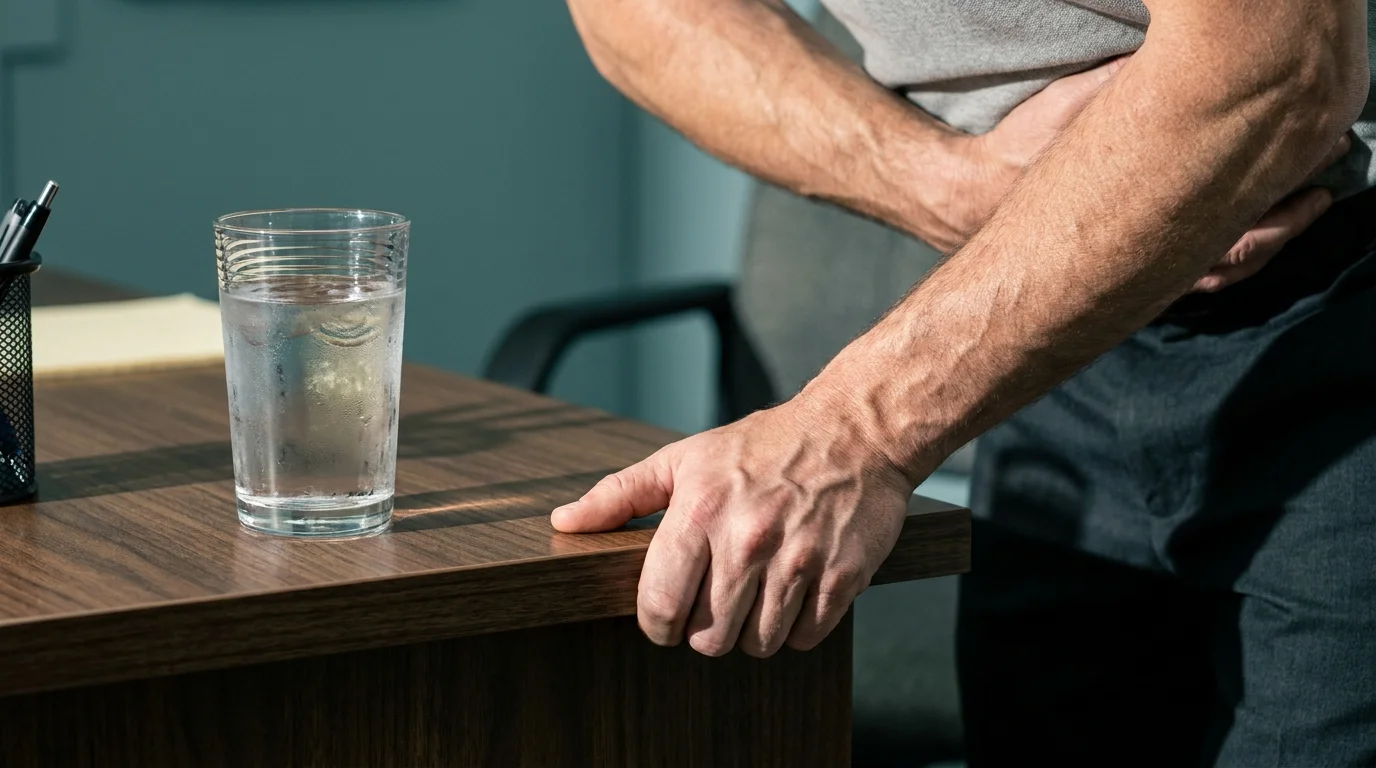
You finally push back from the desk edge, plant your feet, and push yourself upright to head toward the kitchen. In an instant, the room loses its gravity. The floor drops half an inch beneath your socks, the corners of your vision dissolve into a soft gray mist, and your balance vanishes entirely before your palm instinctively slaps down onto the tabletop to arrest the fall.
Your instinctive diagnosis is almost automatic: you tell yourself you simply forgot to hydrate. You glance back toward the desk at your stainless steel tumbler, still cold and half-empty from constant refills throughout the morning. You have had plenty of fluids, yet your chest is suddenly hammering as your pulse scrambles to rebalance your head.
What just occurred was not a failure of thirst. It was an acute mechanical traffic jam deep inside your midsection, where prolonged physical stillness allowed a massive volume of your circulating blood to settle like silt at the bottom of a riverbed.
The Splanchnic Reservoir and the Gravity Trap
Your circulatory system functions less like an open bucket and more like a sensitive network of pressurized garden hoses. When you sit without standing for hours, your abdominal cavity transforms into a passive storage tank. The vascular network weaving through your digestive organs—known clinically as the splanchnic bed—is capable of holding over a quarter of your body’s entire blood supply at any given moment.
During long stretches of immobility, the tiny smooth muscles wrapped around these deep abdominal veins relax. Without the natural rhythmic squeeze of your diaphragm taking full, deep breaths, and without your calf muscles contracting to pump venous blood upward against gravity, fluids pool in the gut like water gathering in a sagging ditch.
Gulping down plain water does nothing to instantly fix this geometry. While hydration maintains overall fluid volume in your system, it cannot force that volume out of your relaxed abdominal veins when you abruptly transition from a seated fold to an upright stance. When you stand up in a single fluid motion, gravity immediately yanks whatever free-floating volume remains down toward your hips and thighs.
- Plastic pen biting triggers hidden afternoon jaw clenching and throbbing temple aches
- Ashwagandha bedtime gummies trigger jarring midnight awakenings and sudden racing pulses
- Silicon dioxide fillers in daily vitamins trigger persistent chalky stomach bloating
- Deep bucket chairs squash lower ribs triggering sudden tight chest spasms
- Low laptop stands force downward neck angles triggering throbbing skull base tension
Your brain is perched roughly two feet above your heart. If your internal sensors—the baroreceptors in your neck—fail to instantly squeeze the abdominal reservoir shut, blood pressure crashes before oxygen reaches your optic nerve and temples, leaving you grasping for steady furniture.
A Lesson from the Drafting Table
Consider Marcus, a 44-year-old architectural drafter in suburban Chicago whose workday routinely consists of six-hour design sprints. By mid-autumn, Marcus was experiencing such severe, sudden lightheadedness every time he rose from his drafting chair that he visited an urgent care clinic, convinced his inner ear was failing or his heart was skipping beats.
His blood panels were unremarkable, and his hydration was flawless. It was only when a physical therapist tracked his postural transition habits that the mystery unraveled: Marcus spent hours in a forward slump, compressing his lower ribs while his legs hung completely limp from an elevated drafting stool. By teaching Marcus to systematically fire his core and calves before ever lifting his hips from the seat, the dizzy spells vanished within forty-eight hours without a single medication change.
Adjustment Layers for the Seated Worker
Not every desk worker experiences this gravitational drain in the identical way. Your specific daily habits dictate where the vascular bottleneck forms and how intensely your nervous system reacts.
The Post-Lunch Task Crusher: If you return to your desk immediately after eating a dense meal, your body intentionally shunts extra blood directly into your stomach and intestines to manage digestion. Sitting perfectly still during this process compounds the splanchnic pooling effect. When you stand up abruptly after lunch, the circulatory deficit is twice as severe as it is on an empty stomach.
The Cross-Legged Percher: Tucking one ankle beneath your thigh or wrapping your legs around chair legs creates localized mechanical tourniquets. When you untangle your limbs to stand, those compressed leg vessels suddenly dilate wide open, creating a rapid secondary drop in blood pressure alongside the abdominal stagnation.
The Low-Sodium Sipper: Drinking enormous quantities of plain, unmineralized water while sitting for long hours can actually dilute the baseline sodium levels needed by your vascular walls to maintain tone. Without adequate electrolyte balance, your blood vessels stay slack, sluggishly slow to constrict when gravity demands an immediate response.
The Pre-Rise Reset: A Mindful Physical Protocol
You do not need an expensive standing desk or complicated therapies to eliminate afternoon room spins. You simply need to prime the biological pump before changing your elevation.
Treat the transition from sitting to standing as a conscious three-step sequence rather than a mindless jerk. Spend fifteen seconds waking up the dormant muscular pumps in your lower body while your hips are still resting firmly on the chair cushion.
- The Calf Pedal: Plant your toes firmly on the floor and lift your heels as high as possible, pumping them ten times to drive stagnant pooled blood out of the lower leg veins.
- The Abdominal Brace: Gently pull your belly button toward your spine as if preparing for a light tap to the stomach, manually compressing the splanchnic reservoir before your head changes height.
- The Half-Hinge Pause: Rise only halfway out of your chair, pausing for two seconds with your torso tilted forward before standing fully erect.
By pausing momentarily at the halfway mark, you give your carotid baroreceptors the brief moment they require to calibrate internal pressure, ensuring your brain remains fully oxygenated before you take your first walking step.
Reclaiming the Rhythm of the Workday
The sudden dizziness you feel after long hours at your desk is not an omen of declining health or a sign that your body is breaking down. It is simply an honest physical response to an unnatural physical posture. The human vascular system was engineered for continuous micro-adjustments—walking, crouching, leaning, and reaching—not for frozen hours in front of glowing glass.
When you learn to read that fleeting wave of lightheadedness as a mechanical signal rather than a mysterious symptom, your relationship with your workday shifts. You begin to notice the subtle stillness in your ribs before the dizziness ever arrives. By taking responsibility for how blood moves through your physical frame, you restore calm control to your afternoons, proving that the simplest structural adjustments often yield the deepest peace of mind.
Real physical equilibrium is not about forcing your body to endure stillness; it is about giving your circulation the muscular support it needs to carry you upward.
| Key Point | Detail | Added Value for the Reader |
|---|---|---|
| Splanchnic Pooling | Blood accumulates in relaxed abdominal veins during hours of stillness. | Explains why afternoon dizziness persists even when you have had plenty of water. |
| Baroreceptor Lag | Sensors in the neck need 3 to 10 seconds to adjust blood pressure against gravity. | Removes the fear of serious illness by identifying normal cardiovascular delay. |
| Pre-Rise Activation | Pumping calves and bracing the core before standing acts as a manual fluid pump. | Provides an instant, zero-cost physical remedy you can use at any workstation. |
Frequently Asked Questions
Why doesn’t chugging water stop my dizziness when I stand up?
Drinking fluids increases overall blood volume, but water alone cannot force blood out of the relaxed digestive veins in your midsection. Without active muscular contraction, that extra fluid simply sits trapped in your gut and legs instead of reaching your brain.Is this sudden room spin the same thing as vertigo?
No. True vertigo is typically triggered by inner ear disturbances or neurological signals that make the room feel like it is continuously spinning even when lying down. Positional lightheadedness from prolonged sitting is caused by a temporary, transient drop in blood pressure to the brain that clears within seconds.Does crossing my legs at my desk make the problem worse?
Yes. Crossing your legs kinks the femoral veins, trapping blood below the knees. When you suddenly uncross and stand, those vessels open wide, creating an immediate drop in arterial pressure that magnifies your dizziness.How long should I pause before standing up completely?
A brief pause of just two to three seconds at a half-crouch or sitting upright with your core braced is plenty of time for your neck sensors to constrict your blood vessels and stabilize blood flow to your skull.When should I speak with a doctor about standing dizziness?
If your lightheadedness leads to actual fainting, lasts longer than fifteen to twenty seconds, or is accompanied by chest pain, shortness of breath, or slurred speech, you should seek immediate evaluation from a qualified physician.