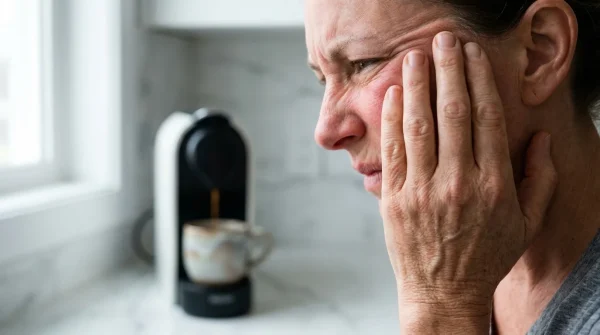
The dull glow of your monitor fades to sleep mode, leaving behind the quiet hum of a laptop cooling fan and a room wrapped in cool dusk. You reach back instinctively with one hand, fingers digging into the gristle along your trapezius. It feels less like supple muscle and more like cured beef, hot to the touch and throbbing with a dull, persistent ache that climbs straight into your temples.
We have all run through the familiar choreography of desk fatigue. You roll your head until your vertebrae click, roll your shoulders backward in sharp half-circles, or jam your knuckles directly into the burning knot just beneath your collarbone. Yet ten minutes later, the band around your cervical spine pulls tight once more, locking your posture into an unyielding, protective defensive brace.
Your instinct tells you to attack where the fire burns brightest, scraping at the nape of the neck or rubbing irritated shoulder tissue raw. But chronic tension rarely surrenders to direct friction; it merely clenches harder against incoming force. The real switchboard sits miles away from the blaze, tucked quietly along the edge of your own resting hand.
The Far End of the Wire: Rethinking the Origin of Tension
Consider the structure of a suspension bridge under steady crosswinds. When the steel cables groan near the center tower, engineers do not hammer the midpoint of the wire to fix the sway. They adjust the base anchor embedded in the bedrock far down the shoreline.
Your upper torso operates along identical kinetic lines. The fascia that swathes your cervical vertebrae does not stop at the collarbone; it threads a continuous spiral down the outer forearm, gliding across the wrist and terminating at the lateral padding of the fifth metacarpal. When you spend six straight hours hovering over a mechanical keyboard or pinching a trackpad, the hand stays frozen in micro-pronation. That silent, curled gripping cascades tension all the way up the arm, anchoring directly into your shoulder blade.
Elena Ruiz, a 44-year-old architectural draftsman from Chicago, discovered this remote connection purely out of desperation during a grueling deadline season. After weeks of applying topical heat patches that only reddened her skin without softening the gravel under her shoulder blades, an occupational physical therapist showed her a subtle acupressure contact point on her palm. Within forty seconds of steady, targeted counter-pressure along the fleshy blade of her hand, Elena felt an odd, warm unraveling across her base of skull—the physical equivalent of a locked turnbuckle suddenly giving way.
- Glossy tablet screens trigger sharp afternoon eyelid twitches by exhausting focal depth
- Flipping cotton pillows resets trapped facial heat and calms racing bedtime pulses
- Heavy laundry baskets strain delicate hip sockets and lock rigid lower back aches
- Back pocket wallets tilt seated pelvis angles and trigger burning lower back aches
- Chlorthalidone pill batches face urgent recall over faulty dissolution testing failures
Adjustment Layers: Customizing Pressure for Daily Ergonomics
Different desk habits breed unique structural twists. Tuning your approach ensures you address the specific angle where your kinetic chain binds most aggressively.
For the Keyboard Heavyweight
If your daily work involves rapid-fire typing, your pinky finger sits in constant hovering abduction, straining the hypothenar muscle group. Your priority lies along the lateral cushion roughly an inch below the base knuckle. Sustained friction here releases the ulnar nerve pathway, dampening the signal that tells your upper trapezius to pull toward your ears.
For the Trackpad & Mouse Specialist
Those who grip a vertical or standard optical mouse all day sustain persistent pressure against the heel of the palm. For this pattern, focus your thumb pressure directly into the crease between the outer palm pad and the wrist bone. By softening this structural hinge, you release the rotational torque that forces your shoulder blade to wing outward.
For the Smartphone Scroller
Mobile device use forces the hand into an inward cradle while the thumb flutters constantly, producing deep tension across the palmar fascia. Sliding your working thumb along the outer rim while actively flexing and extending the fingers helps dissipate the static strain before it travels up the arm and freezes your neck.
The Mindful Reset: A Step-by-Step Palm Release
You do not need specialized tools, wooden dowels, or athletic tape to reset this pathway. The treatment relies entirely on the steady warmth and precision of your opposing thumb.
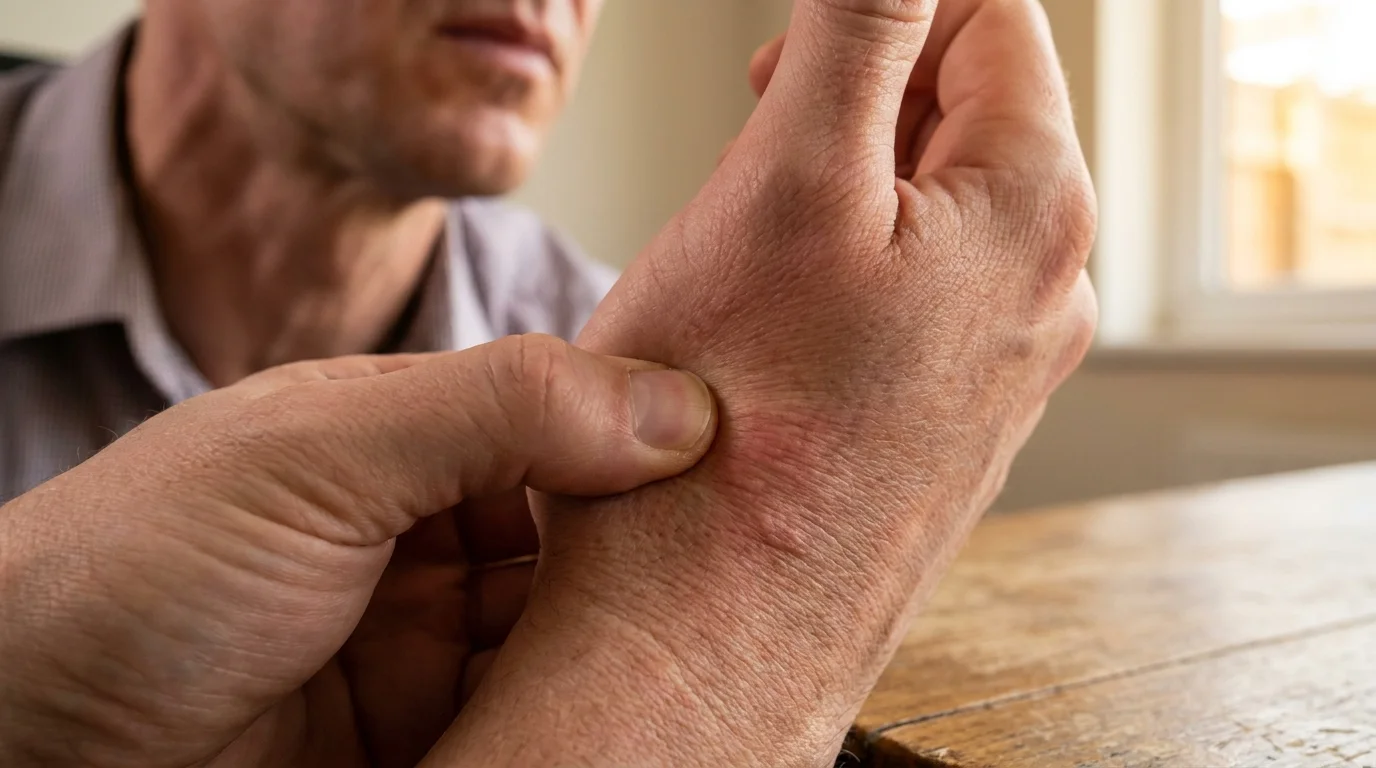
- Locate the tender valley: Rest your left hand on the desk, palm facing inward. Find the prominent knuckle of your little finger, then slide your right thumb about half an inch down toward the wrist along the fleshy outer edge until you find a distinct, slightly tender depression.
- Engage with anchored compression: Press the pad of your thumb firmly into that sweet spot, angling the force inward toward the center of your palm rather than simply squishing the skin sideways.
- Breathe into the release: Hold this steady, sustained pressure for a full 45 seconds while taking three slow, deliberate belly breaths; do not knead or grind aggressively.
- Introduce micro-movement: While maintaining the deep compression, slowly turn your chin over your left shoulder, feeling the sudden ease in your range of motion as the tissue unbinds.
Think of this as a quiet somatic ritual rather than an aggressive workout. Consistency trumps forceful effort every single time, retraining your nervous system to drop its armor during long seated stretches.
The Tactical Toolkit
To integrate this habit without breaking your working cadence, follow these baseline parameters:
- Target Frequency: Twice per workday, ideally at the 11:00 AM slump and during the 3:30 PM energy dip.
- Pressure Gauge: Aim for a 6 out of 10 on the discomfort scale—deep, clear, and relieving, never sharp or electric.
- Hold Window: 40 to 60 seconds per side, allowing ample time for the superficial fascia to warm and soften.
The Bigger Picture: Reclaiming Autonomy Over Daily Strain
Modern desk work often convinces us that physical discomfort is the non-negotiable tax we pay for making a living behind screens. We learn to accept the burning knot between our ribs and the stiff tilt of our neck as inevitable background noise. But when you discover that a deliberate touch to the side of your hand can quiet a raging fire in your upper back, your relationship with your body shifts.
You no longer have to wait for an expensive monthly massage or an appointment on a treatment table to feel ease in your own frame. Relief becomes a discrete, portable skill that lives right at your fingertips, available whenever the day threatens to pull your shoulders to your ears.
Small kinetic levers move heavy anatomical weights; when you clear the tension at the shoreline, the entire bridge rests in stillness.
| Key Point | Detail | Added Value for the Reader |
|---|---|---|
| Primary Trigger Zone | Lateral edge of the hand, just below the fifth metacarpal head (the pinky knuckle base). | Pinpoints the precise sensory junction that bypasses sensitive neck nerves while easing muscular tension. |
| Mechanistic Cascade | Decompresses the ulnar myofascial line running through the forearm to the scapula. | Explains why rubbing your sore shoulders rarely provides lasting relief compared to remote anchors. |
| Tactical Application | 45-second static sustained thumb pressure coupled with gentle cervical rotation. | Provides an invisible, quiet routine you can perform in the middle of a meeting without tools. |
Frequently Asked Questions
How hard should I actually press along the outer edge of my hand?
Use firm, steady pressure that creates a dull, satisfying ache—roughly a 6 out of 10 intensity. You want enough depth to engage the tissue beneath the skin, but never so much force that your fingers tingle or you hold your breath.Why does an ache below my pinky finger affect my upper shoulder blade?
Connective tissue and muscular sheaths form an unbroken chain from your little finger up the back of your arm directly to the scapula and cervical spine. Chronic gripping binds this entire kinetic track, making the hand the master control valve for shoulder tightness.How soon should I expect to feel my neck stiffness soften?
Most people experience a subtle warming sensation and an immediate increase in head-turning range within 30 to 45 seconds of holding the point. The relief is mechanical and reflexive rather than gradual.Can I do this technique while sitting on a video conference call?
Yes, and that is one of its greatest strengths. Because your hands rest naturally on your desk or lap, you can apply pressure discreetly under the frame of your webcam without alerting colleagues or breaking concentration.Will this replace my evening stretching and posture exercises?
Think of this manual pressure as an immediate circuit breaker to stop runaway spasm during the day, while full-body movement and posture awareness keep your structural alignment strong over the long run.