The dull throb rarely announces itself with fanfare. You slide behind the steering wheel on a damp Tuesday morning, flick on the defroster, and pull out into traffic. The leather seat feels firm, your commute stretches ahead, and for the first ten minutes, everything hums along smoothly. But by mile fifteen, an insidious warmth begins to radiate across your right hip, curling inward like a hot wire drawn beneath the waistband of your jeans.
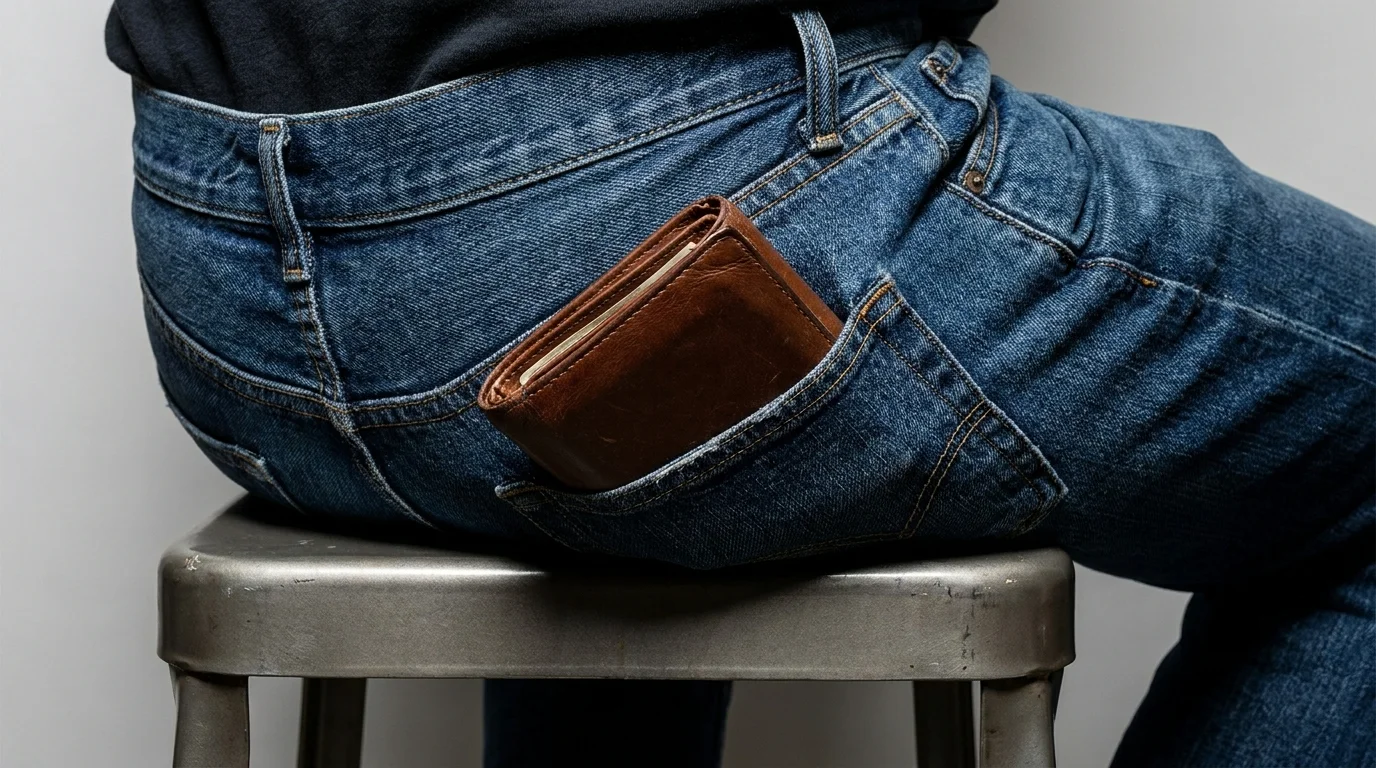
You shift your weight to the left cheek. You stretch your torso taller against the headrest, trying to shrug off the stiffness gathering at the base of your spine. Most mornings, you chalk it up to aging, your mattress, or that hurried lift of a grocery crate over the weekend. You never suspect the small leather brick tucked snugly beneath your right rear pocket.
That folded rectangle of receipts, cards, and worn paper measures barely an inch and a half thick. Yet, every single time you sit down, it acts as an invisible wedge driven directly under one side of your pelvis. It takes only a few minutes for your skeletal foundation to twist, leaving your muscles to fight a desperate, silent battle just to keep your eyes level with the horizon.
The Slanted Foundation: Why Your Spine Is Fighting Gravity
Imagine setting up an office desk where one leg rests on a thick hardback novel while the other three touch the bare hardwood floor. Over hours and days, anything resting on that surface will slide, tilt, and strain against its own joints. That is precisely what unfolds when you settle into a chair with a loaded wallet wedged beneath your rear.
When one side of your pelvis is elevated even half an inch, your sacrum tilts sideways. Because your inner ear demands that your gaze remain horizontal, your lumbar spine must compensate by curving back in the opposite direction. Your lower lumbar vertebrae twist into an unnatural, continuous arc, pinching the delicate cushion discs while overstretching the deep stabilizers on the opposite flank.
Worse still is the direct compression on the piriformis muscle. Nestled deep behind the glutes, this band of tissue lies directly above the sciatic nerve—a primary electrical cable running down your leg. Pinning that nerve between a dense packet of credit cards and the hard bone of your pelvis turns a simple sitting session into a slow, grinding vise grip.
- Chlorthalidone pill batches face urgent recall over faulty dissolution testing failures
- Ground turmeric tea soothes throbbing joint aches and clears heavy morning stiffness
- Under-desk space heaters pool lower leg blood flow triggering sudden room spins
- Blackstrap molasses spoonfuls resurfaced as proven relief for creaky winter knee joints
- Eucalyptus oil drops in hot morning showers lock delicate nasal passages shut
The Cabinetmaker Who Lost His Stride
Consider David Vance, a 48-year-old custom cabinetmaker from Grand Rapids. David spent thirty years bending, hauling maple planks, and driving between job sites, accepting a low-grade, burning ache in his lower back as the price of honest trade. When the dull fire started crawling down his right calf, he assumed a herniated disc had finally caught up with his spine. It was only when an orthopedic physical therapist asked him to empty his pockets that the real culprit surfaced: a bifold wallet packed with four years of hardware receipts, measuring two full inches thick. Within seventy-two hours of transferring that miniature anvil to his front pocket, the persistent burn that had haunted David’s driving days evaporated completely.
Where the Tilt Strikes Hardest: Three Sitting Archetypes
Not every chair treats an unlevel pelvis the same way. The shape of your seat and the duration of your stillness dictate exactly where the strain surfaces.
The Long-Distance Commuter
Bucket seats in modern cars are sculpted with raised lateral bolsters designed to hold your body in place around turns. When you introduce a back-pocket bulge into this contoured cradle, the effect multiplies. The bucket seat locks the asymmetry firmly in place, giving your pelvis nowhere to roll. If you drive over thirty minutes twice a day, your right-side piriformis muscle remains in an unbroken state of ischemic contraction, starving the surrounding tissue of fresh oxygen and firing off false sciatica warnings down your hamstring.
The Desk-Bound Craftsman or Office Worker
Ergonomic office chairs with firm mesh or dense foam do not yield to leather. While a soft living room sofa might cushion the blow by letting your wallet sink into the cushions, an office chair pushes back with equal force. Sitting eight hours atop a firm surface forces your quadratus lumborum—the thick muscle stabilizing your lower back—to remain continuously contracted on the high side to prevent you from toppling over sideways.
The Bench and Bleacher Sitter
Hard wooden dining chairs, workshop stools, and stadium benches offer zero give. On these surfaces, the wallet acts like a stone. The pressure point focuses directly onto the ischial tuberosity, colloquially known as the sitting bone. Within twenty minutes, the direct bone-on-leather contact sparks sharp, local tenderness that makes standing up straight feel like unfolding a rusty hinge.
The Mindful Reset: Restoring Your Pelvic Horizon
Correcting this mechanical tilt requires no expensive appointments or high-tech braces. It asks only for a clean break from an unconscious habit and a few intentional, mindful adjustments to help reset your pelvic baseline.
Begin by treating your rear pockets as purely decorative. When you sit down, your sitting bones should meet the chair with equal, mirrored pressure.
- Empty before you sit: Make tossing your wallet into the center console of your car or placing it on your desk beside your keys a non-negotiable ritual before your hips touch the cushion.
- Adopt the front-pocket switch: Transition to a slim card sleeve or money clip carried strictly in your front trouser pocket, where hip flexion naturally accommodates the bulk without warping your posture.
- The Ninety-Second Seated Unwind: Sit on the front edge of a sturdy chair with both feet flat. Cross your right ankle over your left knee, creating a figure-four shape. Keeping your spine tall and proud, gently hinge forward from the hips until you feel a clean, sweet tension deep within the glute. Breathe calmly for five slow breaths, then switch sides.
- Perform the pelvic tilt check: Place your palms flat against the front points of your hip bones while seated. Close your eyes and notice if one side rests even a quarter-inch higher than the other. Level your hips consciously before starting your work.
The Tactical Toolkit
- Maximum Thickness: Keep your daily carry under 0.4 inches (10 mm) total profile.
- Audit Frequency: Strip out expired receipts, store cards, and loose paper once every Sunday evening.
- Relief Duration: Spend 3 minutes post-commute in a relaxed low-lunge stretch to open the hip flexor on the previously compressed side.
The Quiet Freedom of an Unburdened Seat
We often look for dramatic explanations when our bodies push back against modern life. We suspect spinal degeneration, blame our shoes, or worry that our core muscles have surrendered to time. Yet, the body is an honest ledger of mechanical physics; it simply responds to the structural forces we impose upon it hour after hour.
When you strip away that lopsided wedge, your sacrum settles back into its natural cradle. Your lower spine exhales, shedding the compensatory twist it held all morning. Standing up from your desk no longer demands a guarded wince or a hand braced against your lower back. Real physical peace often hides in these tiny, unglamorous adjustments—a recognition that restoring balance to your day can be as simple as clearing your pockets and letting gravity do its quiet, steady work.
The spine forgives honest physical labor, but it quietly revolts against a lopsided foundation.
| Key Point | Detail | Added Value for the Reader |
|---|---|---|
| Pelvic Hemipelvis Elevation | A 1-inch wallet creates a 10 to 15-degree lateral tilt in your sacral base while seated. | Allows you to understand that lower back fatigue is often a math problem, not a spinal disease. |
| Sciatic Compression | Pinning the sciatic nerve between the wallet and pelvic bone mimics true disc-related sciatica. | Saves you from unnecessary clinical testing by testing a simple postural fix first. |
| Quadratus Lumborum Strain | The muscle opposite the wallet remains locked in continuous contraction to balance the head. | Explains why the ache often lives on the side opposite where your wallet is kept. |
Frequently Asked Questions
How long after removing my wallet will the burning ache subside?
Most people notice a dramatic decrease in hip stiffness and lower back warmth within three to five days of sitting completely level. If soft tissues around the sciatic nerve were inflamed, full calming can take up to two weeks of consistent, level seating.Does a thin bifold wallet cause the same postural damage?
Even a quarter-inch profile introduces an artificial asymmetry when held under your sitting bones for multiple hours. While the nerve compression is less acute, the lateral pelvic tilt remains active, slowly fatiguing the stabilizing muscles of your lumbar spine.Why does my back hurt on the opposite side of where I keep my wallet?
Your spine works like a crane. When the right hip is propped up, the muscles on your left flank must contract relentlessly to pull your upper torso back toward center. That continuous, unpaid muscular overtime is often where the deepest ache settles.Is keeping my wallet in my coat pocket or bag a better alternative?
Yes, keeping your everyday essentials in a jacket breast pocket, commuter bag, or front trouser pocket removes structural load from your pelvic girdle entirely, preserving natural spinal curves throughout the day.Can driving with a wallet cause long-term nerve damage?
Prolonged piriformis syndrome caused by seated compression can lead to chronic nerve irritation and localized muscle fibrosis if ignored for years. Removing the mechanical irritant early allows the nerve sheath to heal without lasting consequences.