The crisp snap of dry winter air hits your knuckles before you even reach the porch steps. Inside, the radiator hisses rhythmically, stripping whatever ambient humidity remains in the room down to a parched gasp. You glance down at your hands, noticing the angry crimson lines tracing across your middle joints—tiny, stubborn fissures that reopen every time you grip a steering wheel, wash dishes, or reach into your jacket pocket.
Standard water-based lotions promise relief, yet the moment you massage them into those raw fissures, a familiar, white-hot burn flares up. Most commercial hand creams are packed with emulsifiers and preservatives that irritate broken tissue, offering a fleeting slickness that evaporates within twenty minutes. Your skin stays parched underneath, drying out faster than before, caught in a cycle of cracking, stinging, and futile reapplications.
True relief does not come from thinning out moisture across the surface; it requires sealing the fissure entirely from ambient oxygen. When raw nerve endings encounter dry room air, they scream. Intercepting that contact demands a viscous, biological barrier that cushions the split while actively pulling restorative fluid upward from deeper tissue layers.
The Liquid Shield: Rethinking How Cracked Skin Heals
Consider a split knuckle not as an ordinary surface blemish, but as an open gorge in dry soil. Slathering liquid lotion over a fissure is like spraying light mist across cracked desert clay—the water beads, runs down the sides, and evaporates before the deeper earth can absorb a single drop. Raw exposed nerve endings require an immediate physical barricade, a dense canopy that halts stinging air contact instantly.
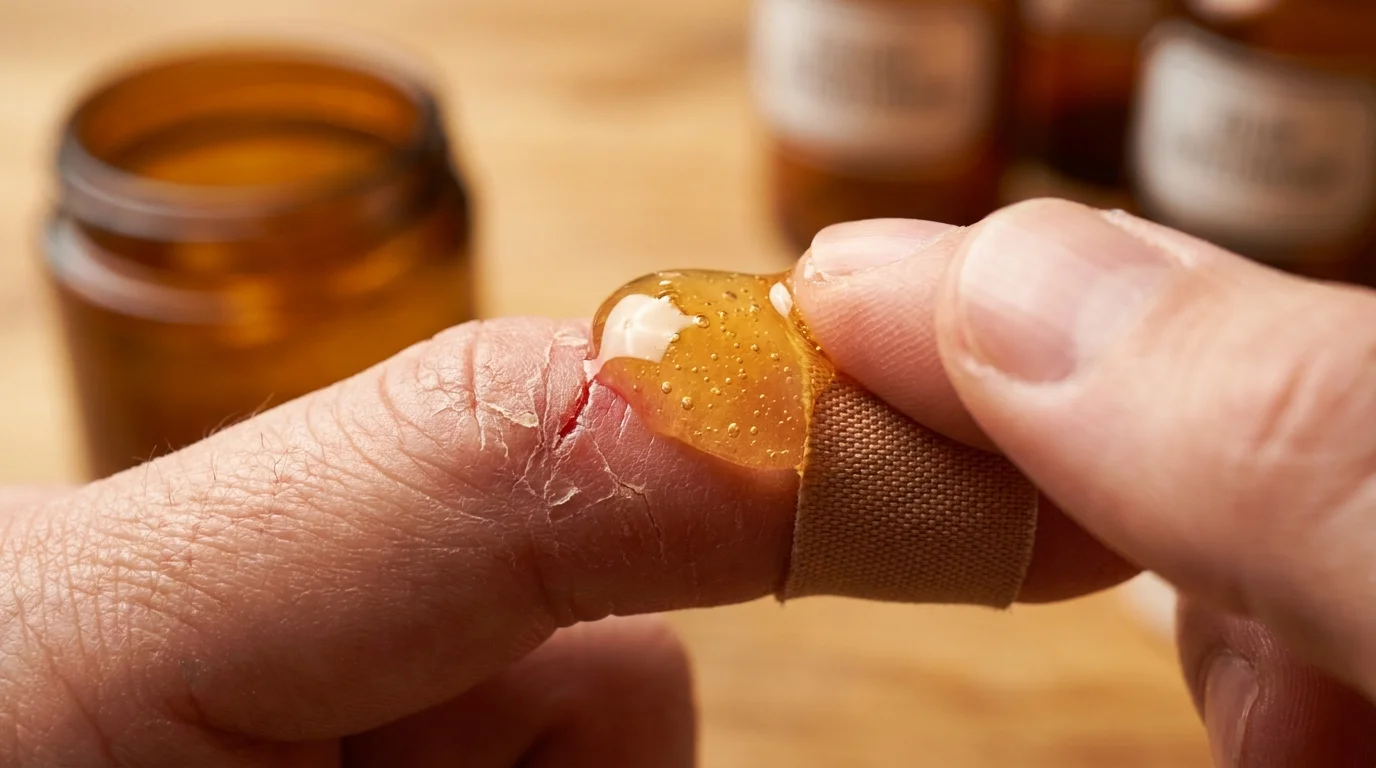
This is where Manuka honey bandages rewrite the script. Unlike common clover honey, medical-grade Manuka contains concentrated levels of methylglyoxal (MGO), an active compound that defends the wound bed while sustaining an intensely low pH. When applied directly to a raw joint, its thick, amber consistency creates a fluid-impervious vault. It acts like liquid amber preserving delicate tree bark, trapping vital moisture beneath its weight while neutralizing stinging ambient draft.
Instead of drying into a crusty, tight scab that snaps open the moment you bend your fingers, the honey creates an osmotic draw. It gently summons lymphatic fluid from surrounding capillaries into the fissure, bathing the ragged edges in the body’s own restorative peptides. The split remains pliable, soft, and shielded from friction, allowing the skin margins to bridge the divide without tension.
- Small spreadsheet fonts strain delicate brow muscles triggering stubborn afternoon eyelid twitches
- Hot peppermint vapor swells delicate nasal passages shut triggering heavy head pressure
- Baked salmon fillets washed down with mineral tonics spark painful belly bloating
- Covering LED chargers with dark tape blocks midnight glare for deep unbroken sleep
- Warm bone broth mugs flush vital body salts and trigger midnight calf spasms
Dr. Elena Vance, a 48-year-old clinical dermatologist in Minneapolis who spends her weekends restoring antique hardwood furniture, saw this cycle daily in her woodshop and her clinic. “People treat split knuckles like dry skin when they should treat them like micro-incisions,” she often tells her patients. Last winter, with her own thumbs raw and split from handling rough cedar boards and solvent washes, she abandoned heavy paraffin creams in favor of medical-grade Manuka strips, finding her fissures closed securely within forty-eight hours without a single sting.
Tailoring the Seal: Matching Application to Your Day
Not every crack across your knuckles demands the same treatment schedule. Your skin weathers different stresses depending on how your hands earn their keep, making deliberate application crucial for all-day comfort.
For the Constant Hand Washer
If your daily work involves frequent soapy rinses—whether you are working in healthcare, food service, or wrangling small children—ordinary bandages turn soggy and peel off within an hour. For this rhythm, use a pinhead dot of high-potency Manuka directly in the fissure, followed by a breathable, flexible fabric dressing topped with a waterproof tape seal. The honey maintains its cohesive barrier beneath the bandage, repelling moisture washouts and keeping the fissure calm through repetitive scrubbing.
For the Outdoor Trades and Winter Commuters
When sub-freezing winds bite your hands, cold temperatures cause peripheral blood vessels to constrict, making skin stiff and brittle. Apply your honey compress at room temperature just before pulling on insulated gloves. The dense botanical barrier prevents abrasive wool or synthetic lining fibers from catching on rough, jagged skin edges, eliminating that agonizing snag whenever you flex your grip.
The Mindful Night Compress: A Step-by-Step Application
Nighttime is your greatest window for deep dermal recovery. While you sleep, involuntary finger movement decreases, allowing the dense barrier to remain undisturbed for hours. Transforming this simple habit into an evening wind-down routine guarantees you wake up without the morning sting.
Clear the canvas first by washing your hands in lukewarm—never hot—water using a fragrance-free, oil-based cleanser. Pat your knuckles dry gently with a clean cotton towel, ensuring you do not pull or widen the split. Avoid rubbing; gentle pressure is all you need to lift surface dampness.
- Select medical-grade Manuka: Look for an authentic rating of UMF 10+ or MGO 250+ to ensure the honey carries adequate viscosity and bio-active strength.
- Target the crevice directly: Squeeze a teardrop-sized dollop onto the pad of a sterile strip or directly into the split using a clean cotton swab.
- Anchor with flexible tension: Wrap the bandage around the joint while keeping your finger bent at a gentle forty-five-degree angle so the dressing accommodates daytime movement.
- Lock with breathable cotton: Slip a pair of thin, untreated white cotton gloves over your hands to keep the bandages securely anchored against your sheets.
By keeping the finger slightly flexed during dressing, you ensure the adhesive will not pull taut or shear against raw skin when you clench your fist overnight. You wake to calm, settled knuckles instead of tight, bleeding edges.
The Quiet Confidence of Comfortable Hands
Our hands are our primary bridge to the tactile world. When every touch, grip, and morning greeting sends a sharp jolt of stinging pain through your fingers, your entire nervous system stays quietly braced on edge. You withdraw your touch, handle tools with hesitation, and tuck your fists into pockets to hide raw, bleeding fissures from sight.
Restoring these small, hardworking joints with a gentle, time-tested botanical shield does more than just patch torn tissue. Reclaiming pain-free tactile freedom changes how you interact with the day, turning mundane rituals like holding a warm ceramic mug or shaking a colleague’s hand back into effortless, unconscious moments of connection. When your hands feel whole, you move through the world with ease.
“Healing happens best in the quiet dark beneath a protective barrier, where skin is finally allowed to close without fighting the air.”
| Approach | Mechanism | Added Value for the Reader |
|---|---|---|
| Standard Water-Based Lotion | Spreads emulsifiers and water across outer layers, evaporating rapidly. | Provides temporary surface softening but often triggers immediate burning and re-cracking. |
| Petroleum Jelly Dressing | Forms an occlusive synthetic vapor lock over the epidermis. | Stops dehydration effectively, yet lacks natural bio-active compounds to assist the wound bed. |
| Medical Manuka Honey Bandage | Creates a viscous osmotic barrier that draws lymphatic fluid while buffering raw nerves. | Stops air-contact sting instantly and maintains edge elasticity through repeated joint flexing. |
Frequently Asked Questions
Will regular grocery store honey work the same way?
Store-bought culinary honey is often pasteurized, which diminishes beneficial enzymes, and it may contain wild pollen spores. Always reach for sterile, medical-grade Manuka honey to safely dress cracked knuckles.Why does my split knuckle burn when I use regular lotion?
Lotions often contain alcohol, water, and synthetic stabilizers. When introduced to open fissures, these chemical agents trigger sensitive raw nerve endings, causing that sharp, instant stinging sensation.How long should I leave a honey bandage on?
A single dressing can remain securely in place for twelve to twenty-four hours. Changing it once daily, ideally before bed, gives the fissure undisturbed rest while keeping the dressing clean.Does the honey stay sticky beneath the bandage?
The honey naturally integrates with tiny amounts of your skin’s own moisture, remaining thick and jelly-like rather than messy, which keeps the dressing from adhering painfully to the raw split.Can I wash dishes while wearing the honey bandage?
Yes, provided you cover the fabric dressing with a waterproof outer adhesive or wear protective unlined rubber gloves to prevent soapy water from diluting the honey seal.