Your ribcage tightens until breathing feels like pulling air through wet wool. The pulse behind your ears quickens into a frantic hammer, and the room seems to lean inward, draining of color. When panic takes the wheel, thoughts loop like a scratched record, replaying worst-case scenarios with terrifying momentum. You are told to practice calm, slow breaths or visualize quiet meadows, but when the adrenaline surge hits, your cognitive mind is already offline.
Trying to reason your way out of a visceral terror response is like negotiating with a flash flood. Your nervous system has seized command, diverting blood flow to large muscle groups and shutting down rational introspection. The intellectual tools you rely on during calm afternoons simply evaporate under the chemical weight of acute fight-or-flight.
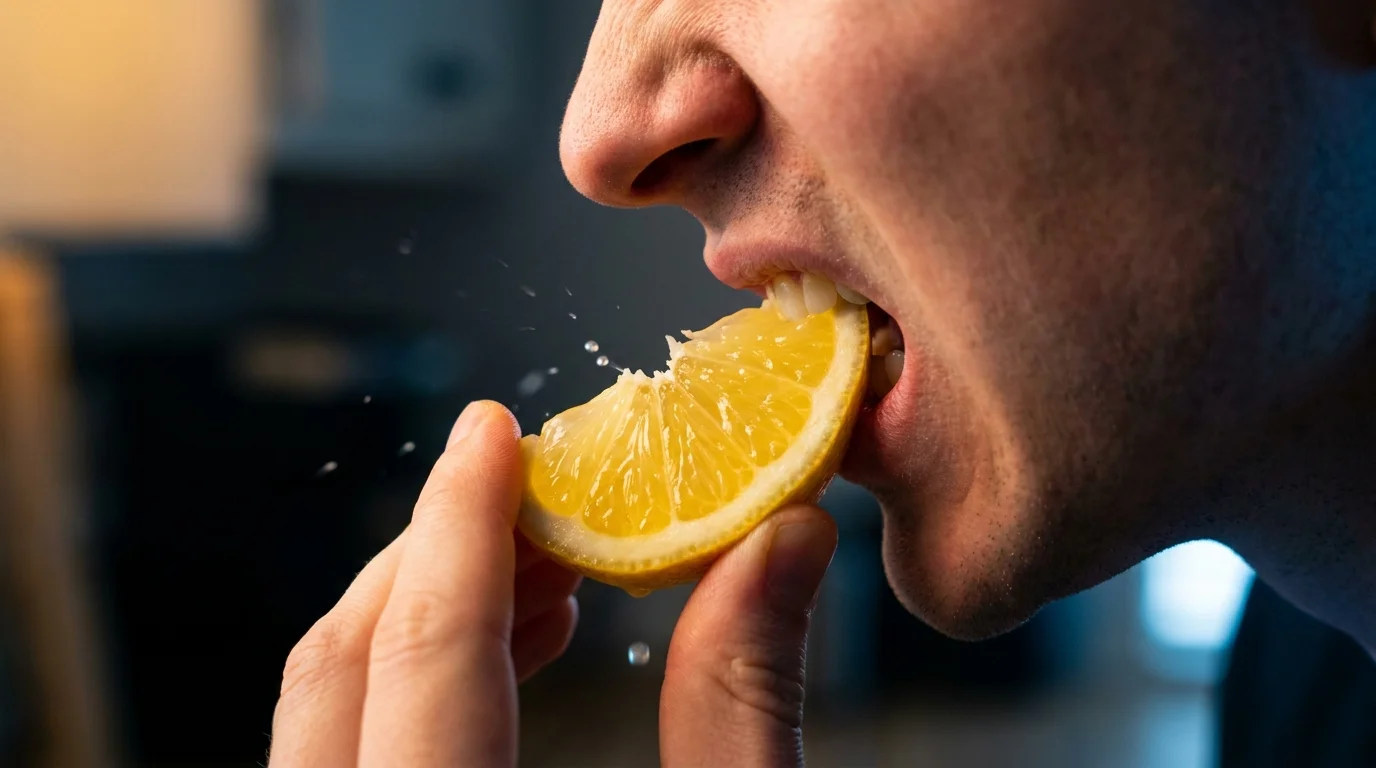
Now picture standing over a clean kitchen counter. You pick up a paring knife and slice straight through a cold, unpeeled lemon. Drops of sharp, pale juice bead along the yellow rim, misting the air with a bitter, clean brightness. You do not sniff it politely or drop it into sparkling water; you press the raw, exposed pulp directly between your back molars and bite down hard.
The impact is immediate, almost violent in its puckering intensity. Salivary glands spasm awake, your eyes squeeze shut, and the bitter acidity hits your tongue like a strike of lightning. Panic cannot survive sensory shock of this magnitude. In a split second, the looping abstractions in your prefrontal cortex crumble, dragged downward into the undeniable, physical reality of extreme sourness.
The Neural Circuit Breaker: Why You Cannot Out-Think a Flood
Panic is not a failure of character or a lack of mental discipline; it is an autonomic misfire. When your amygdala perceives an invisible threat, it floods the bloodstream with catecholamines, preparing you to flee a predator that does not exist. The loop feeds on itself: you notice your racing heart, assume you are dying, and that dread accelerates your heart further.
To stop this runaway train, you need a physiological circuit breaker rather than a gentle suggestion. Sensory inputs share neural wiring, and extreme stimuli always win priority access to your processing centers. Biting into a lemon recruits the cranial nerves—specifically the trigeminal and glossopharyngeal pathways—with such overwhelming force that your brain drops its conceptual panic loop to address an immediate physical event: the arrival of high-potency citric acid.
- Daily iron supplements stall natural digestive pacing behind outdated morning guidelines
- Canola cooking oil releases harsh airborne fumes sparking sudden post-dinner brain fog
- Taking elevator rides accelerates quiet leg strength loss and ruins walking balance
- Wiping low baseboards strains fragile knee joints sparking stubborn morning stiffness
- Kind breakfast bars trigger sudden afternoon fatigue and ferocious sweet cravings
Consider Marcus Vance, a 38-year-old architectural drafter from Denver whose panic surges routinely crippled his afternoons before client presentations. Traditional mindfulness exercises left Marcus trapped in his head, tracking his own suffocating heartbeat until his hands shook uncontrollably. A somatic specialist handed him a wedge of fresh citrus and told him to bite past the pith the moment his fingers went numb. The sour assault derailed the episode in under twenty seconds, grounding him through brute-force taste receptors before the cognitive spiral could lock his chest.
Tailoring the Shock: Adapting the Citrus Pivot to Your Environment
Not every panic surge occurs in a quiet kitchen within arm’s reach of a cutting board and a crisper drawer. Adapting this sensory reset means matching the intensity of the trigger to your specific daily environment without turning it into a burdensome chore.
For the Desk-Bound Professional: Stashing whole fruit at an open-plan office desk can feel awkward, but keeping crystallized unsweetened lemon packets or intensely sour lozenges in your top drawer provides the exact same trigeminal disruption. The key is steering clear of sugary candy; you want genuine, cheek-pulling malic or citric acid that forces your facial muscles to contract.
For the Midnight Spiraler: Waking up at 2:00 AM with racing thoughts is uniquely disorienting because sensory stimulation is at absolute zero. Keeping a few pre-sliced citrus wedges in a small glass container inside your refrigerator introduces an added shock layer: the contrast of freezing temperature paired with mouth-drying acidity, pulling you out of the dark void and planting you firmly on the linoleum floor.
For the Highly Sensitive Palate: If intense acidity triggers gastric reflux or oral sensitivity, you can adjust the dial without losing the neurological benefit. Grating fresh lemon zest against the back of your hand and pressing your tongue into the pungent essential oils provides an aromatic and bitter kick potent enough to clear the fog without overloading your stomach.
The Emergency Bite: A Tactical Protocol for Acute Spirals
Using citrus as a sensory rescue tool is an active somatic override, not an exercise in passive relaxation. When you feel the familiar tightening in your throat or the cold wash of dread over your shoulders, move with deliberate, mechanical focus.
- Retrieve the raw wedge: Cut a thick quarter-slice of fresh lemon, keeping the rind intact so you have something firm to anchor between your fingers.
- Engage with the full bite: Place the raw pulp squarely on the center of your tongue and bite down firmly, letting the juice flood the sublingual tissue and the back of your throat.
- Notice the physical recoil: Allow your facial muscles to pull tight, pay attention to the involuntary surge of saliva, and track the prickle along your jawline.
- Anchor the breath on the exhale: As the immediate shock recedes over five to ten seconds, release a long, audible sigh through slightly parted lips.
The goal is not to enjoy the flavor, but to leverage the body’s natural defense against extreme tastes. The nervous system instantly categorizes this sudden burst as high-priority information, clearing out background mental static to focus entirely on the mouth.
Reclaiming the Body as an Ally, Not an Alarm
When you live with recurring anxiety, you start viewing your own physical sensations as traitors. A skipped beat, a sudden sweat, or a shallow breath feels like the opening salvo of a catastrophe you cannot prevent. You retreat further into your head, trying to police every twitch, which only deepens your vulnerability.
Keeping a lemon in your crisper drawer turns that dynamic on its head. Your physical body holds answers that raw willpower cannot generate, offering simple sensory backdoors that silence internal alarms faster than hours of self-talk. You do not need to fight your mind when it begins to spin out of control; you simply need to offer it a physical sensation so undeniable that everything else falls quiet.
When the primitive brain believes it is drowning in smoke, you do not recite poetry; you crack open a window.
| Key Point | Detail | Added Value for the Reader |
|---|---|---|
| Primary Neural Target | Trigeminal and glossopharyngeal cranial nerves | Explains why intense taste halts panic faster than conscious thought. |
| Citric Shock Threshold | Unsweetened juice below 2.5 pH | Prevents using sugary candy that fails to spark the full reflex. |
| Salivary Rebound Window | Immediate 15-to-30 second autonomic reset | Gives you a clear timeline for when racing thoughts begin to quiet. |
Frequently Asked Questions
Does this method work if I already know the sour taste is coming?
Yes. The reflex is physiological rather than psychological; the shock to your taste receptors and salivary glands occurs automatically regardless of your mental anticipation.Can I use bottled lemon juice instead of fresh fruit?
Bottled juice works in an emergency, though a raw, cold wedge provides the extra tactile shock of temperature, scent, and texture that strengthens the grounding effect.Will the acidity damage my tooth enamel if used frequently?
Swish your mouth thoroughly with plain water thirty seconds after biting the wedge to neutralize the acid, and avoid brushing your teeth for at least thirty minutes afterward.How is this different from eating sour candy during an attack?
Most commercial sour candies carry a heavy sugar coating that softens the sensory blow; pure raw citrus delivers an unbuffered shock that triggers an instant autonomic pause.What if biting a lemon makes me feel startled or overwhelmed?
That brief startle is precisely what breaks the anxiety loop; allow the facial spasm to happen, then focus your attention entirely on the sudden rush of saliva in your mouth.