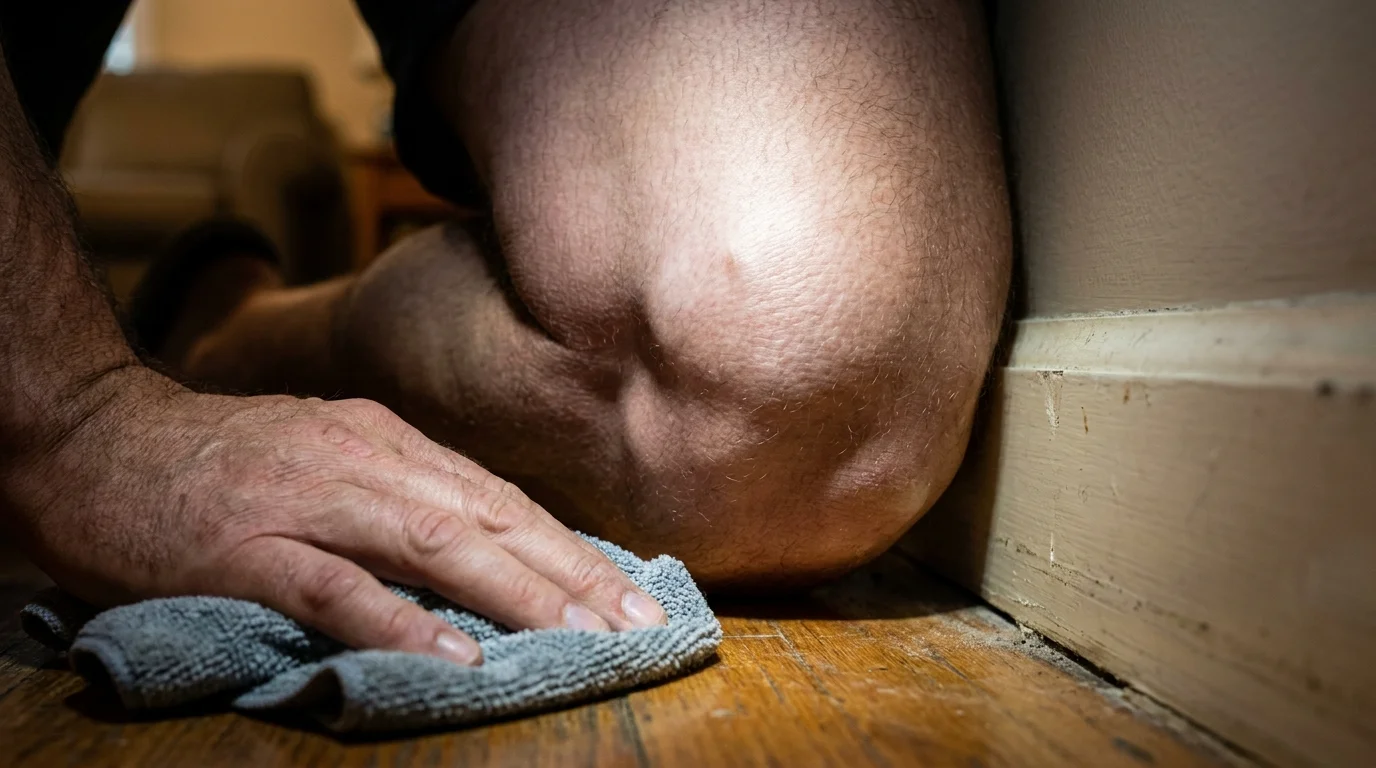
The Saturday sun cuts across your baseboards, highlighting a gray film of fine dust, pet dander, and shoe scuffs that suddenly demands your attention. You grab a microfiber rag, fill a bucket with warm water and lemon soap, and sink straight down onto the hardwood. You tuck into a tight crouch or plant both kneecaps hard against the timber, sliding forward inch by inch as you trace the perimeter of the room.
The work feels virtuous in the moment. You watch the trim gleam against the paint, feeling productive as you creep along the floorboards with your weight pressed directly into the floor. But by evening, an invisible dull heat begins radiating from deep inside the front of your legs, settling behind your patella like a pocket of hot sand.
When your alarm rings the next morning and your feet find the rug, the reality sets in. Your knees feel less like living joints and more like hinges packed with stiffening mortar. Bending them to stand upright requires bracing your hands against the nightstand, leaving you wondering why a quiet afternoon of basic tidying has left you walking like you just finished a mountain marathon.
Most adults write off this sudden, stubborn morning immobility as an unavoidable milestone of aging. Yet your joint tissue is not breaking down from years on the clock; it is reacting to an extreme biomechanical vice created by deep, unsupported knee flexion.
The Nutcracker Effect: What Deep Bending Does to Cartilage
To understand why this specific chore wrecks your mobility, you have to look at the geometry of your knee under load. When you stand tall, your kneecap sits loosely in a smooth groove at the end of your thigh bone, gliding effortlessly with almost zero compressive friction.
The moment you bend your knees past ninety degrees to reach the bottom trim, the entire mechanical system changes. Your patellar tendon pulls your kneecap backward with punishing force, pinning it against the femur like a walnut caught inside a heavy metal nutcracker. At this acute angle, compressive forces behind the kneecap can spike to seven times your total body weight, squeezing the delicate synovial fluid straight out of the cartilage matrix.
When you add the hard surface of a floor to that deep bend, the problem doubles. You are not just compressing the joint from the inside via tendon tension; you are trapping the bony structure between your full body mass and unyielding oak or tile. The cellular shock creates microscopic friction tears in the patellofemoral lining, prompting your body to flood the joint capsule with inflammatory fluid overnight, which produces that heavy, locked-up sensation at dawn.
- Kind breakfast bars trigger sudden afternoon fatigue and ferocious sweet cravings
- Collarbone hollow pressing eases stubborn computer neck tightness in minutes
- Measles exposure rules shift hospital triage protocols across emergency departments nationwide
- Rolled doorway towels seal hallway light leaks for deeper uninterrupted night sleep
- Crossing ankles seated tilts pelvic balance to trigger nagging lower back ache
The Clinic Floor: A Physical Therapist’s Saturday Pattern
Dr. Marcus Vance, a fifty-two-year-old orthopedic physical therapist practicing in Denver, sees this exact pattern spike every spring and fall. For decades, he watched active patients in their forties and fifties arrive on Monday mornings convinced they had torn a meniscus over the weekend, only for their scans to reveal clean ligaments and acute patellofemoral irritation.
Marcus recalls one particular patient, a marathon runner who could log fifteen miles without a twinge but arrived barely able to navigate two stairs after spending a Sunday hand-washing the skirting boards in her new home. “People treat household chores as neutral movements,” Marcus explains. “They will warm up for a run, but then drop into an extreme, static four-inch squat on a hard floor for forty-five minutes straight without a second thought. The knee was never designed to bear sustained compressive loads at maximum flexion.”
Matching the Chore to Your Joint Profile
Not every body responds to low floor work in identical ways. Protecting your physical reserves requires recognizing which category your daily habits fall into before you reach for a cleaning cloth.
For the Weekend Perfectionist
If you prefer tackling the entire house in a single, hyper-focused morning sweep, static crouching is your greatest enemy. Staying crouched for twenty minutes along a hallway starves the patella of fluid exchange, causing localized cellular starvation in the joint lining. You must break the perimeter into small quadrants, alternating between low work and standing tasks like wiping high mirrors or dusting crown molding to allow synovial circulation to recover.
For the Pet Household
Homes with dogs or cats collect baseboard buildup weekly rather than seasonally. When cleaning is this frequent, dropping to the floor creates a state of chronic, low-grade inflammatory buildup that never fully clears before the next session. For you, kneeling on the floor must be abandoned entirely; repetitive maintenance demands tools that keep you completely upright.
For the Sensitive or Post-Injury Joint
If you already manage mild arthritis, old sports injuries, or meniscus wear, deep flexion is an immediate inflammatory trigger. Squatting to low surfaces pinches the posterior horn of the meniscus, driving sharp, shooting aches into the back of your calf. Your rule is absolute: your knee angle should never close past sixty degrees during any household maintenance task.
The Standing Sweep Protocol
You do not need to choose between clean baseboards and functional knees. Protecting your cartilage is a matter of shifting your leverage by moving the work up to your natural standing eye line.
By swapping hands-on floor crawling for an extended reaching tool, you eliminate deep joint compression while working faster and covering more ground with zero patellar stress.
- Select a long-reach tool with a contoured swivel microfiber cleaning head that hugs the curves of standard baseboard trim without requiring you to stoop.
- Position your feet shoulder-width apart, keeping your spine straight and your knees soft, never locked or deeply bent.
- Maintain a gentle seventy-degree shaft angle between your tool handle and the wall, using the natural leverage of your arms and shoulders rather than joint-crushing leg power.
- Walk the perimeter at a measured pace, taking smooth, forward strides rather than twisting your torso or planting your feet rigidly in one place.
- Mist the microfiber head lightly with warm water and cleaning fluid rather than soaking it, preventing excess moisture from running down onto your floors.
The Tactical Toolkit
A few deliberate adjustments to your gear will preserve your mobility for years to come:
- Handle Length: Use a lightweight aluminum telescoping pole adjustable between 48 and 60 inches.
- Attachment Head: Choose a curved, dual-sided microfiber head that traps hair instead of smearing it.
- Time Ceiling: Cap any single cleaning session at 15 minutes before taking a two-minute walking break.
- Footwear: Wear supportive, rubber-soled indoor shoes rather than bare feet or slippery socks to stabilize your pelvic base while walking room borders.
The Freedom of Keeping Your Distance
There is a peculiar satisfaction in seeing a room clean down to its lowest edges, but that visual reward should never cost you your morning stride. When you stop treating household upkeep as an athletic punishment and start approaching it through mechanical leverage, your domestic life begins working with your physiology instead of against it.
Waking up without stiffness is not a matter of luck or expensive supplements; it is the natural consequence of respecting the simple physics of your joints. When you preserve your cartilage today, you keep the quiet confidence that tomorrow morning will greet you with effortless, fluid steps.
“Joint preservation is rarely about avoiding heavy weights; it is about eliminating the unconscious, unyielding micro-crushes of your daily domestic routine.” — Dr. Marcus Vance, PT
| Key Point | Detail | Added Value for the Reader |
|---|---|---|
| Biomechanical Load | Deep squats create up to 7x bodyweight compression behind the patella. | Explains the true mechanical source of post-chore morning stiffness. |
| Tool Leverage | A 50-inch telescoping microfiber wand cleans trim from an upright stance. | Completely removes patellar ground pressure and knee cap compression. |
| Fluid Circulation | Synovial fluid requires intermittent motion rather than static, locked crouches. | Prevents cartilage starvation and morning joint inflammation. |
Frequently Asked Questions
Why do my knees hurt the morning after cleaning rather than while I am doing it?
During the chore, warmth and adrenaline mask early irritation. As you sleep, your body sends inflammatory repair fluid into the compressed patellofemoral capsule, causing the joint to feel tight, thick, and locked upon waking.Will using a thick foam kneeling pad protect my joints while wiping trim?
A foam pad softens surface bruising on your skin, but it does nothing to fix the severe mechanical tension inside the joint caused by folding your leg past ninety degrees under body weight.What is the best way to soothe morning stiffness if I already scrubbed the floors?
Skip high-impact movement. Take a warm shower to increase local tissue circulation, perform gentle, unweighted standing leg swings, and walk on level ground for ten minutes to restore synovial lubrication.Can I use a standard floor mop to clean baseboards instead of buying a specialty tool?
Standard flat mops often lack the flexible edge needed to clean the curved top lip of baseboards, forcing you to lean awkwardly; an angled, swivel-head microfiber duster provides the cleanest contact with zero spine or knee strain.Does this knee stress cause permanent damage or just temporary aches?
While an occasional crouch causes temporary swelling, repeating deep static floor scrubbing over years accelerates patellofemoral cartilage thinning and chronic joint wear.