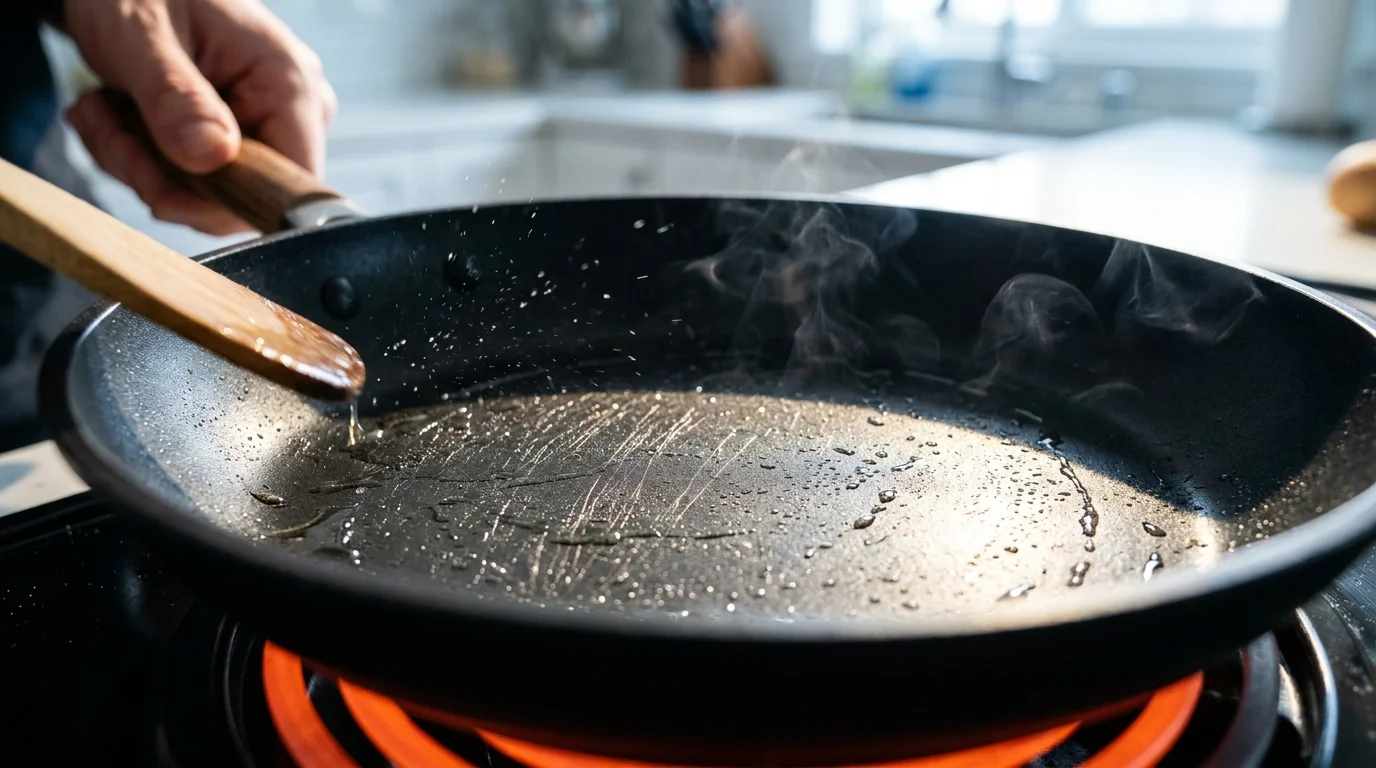
The kitchen is filled with the warm, reassuring hiss of butter melting across a slick charcoal-colored surface. You drop a fillet of salmon into the pan, watching the edges crisp into a pale gold while the stovetop vent hums its steady, low tune. Dinner comes together in twelve minutes flat, slide-out-of-the-pan effortless, just like the packaging promised when you brought that cookware set home.
Yet twenty minutes after you clear your plate, a peculiar weight settles behind your eyebrows. It is not the familiar, drowsy fullness of a hearty meal; it feels more like breathing through a wool blanket, accompanied by a dry, metallic scratch at the back of your throat. Your temples pulse with a dull, vice-like squeeze that makes you reach for a glass of water, assuming you simply took in too much sodium or stared at your work laptop for an hour too long before dinner.
You check the ingredients on your spice jars and wonder if you caught a sudden draft from the patio door. The real culprit, however, has already cooled quietly on the back burner, wiped down with a soft sponge and put back on the hanging rack.
The Thermal Trap Behind the Nonstick Shine
We treat nonstick skillets as if they were indestructible workhorses, cranking the burner to high to achieve that restaurant-style sear on a weeknight steak or stir-fry. But fluoropolymer coatings operate on a fragile mechanical bargain: they are whisper-smooth at low warmth, yet molecularly unravel under standard searing heat. When temperatures push past 460 degrees Fahrenheit—a threshold easily crossed in under three minutes on an empty burner—the slick surface stops behaving like stable cookware and begins releasing micro-particulate airborne vapors.
Think of the coating not as a permanent shield, but like a sheet of pressed candle wax. At room temperature, it is completely inert and harmless to the touch. Once you introduce raw flame or high-wattage induction coils, those tightly coiled synthetic links loosen, aerosolizing tiny chemical fragments into your kitchen air before your exhaust hood can even register the threat.
Because these off-gassing particles are completely invisible and carry almost no distinct burnt odor, your nervous system processes them without warning. You inhale them in the tight confines of your cooking space, where they spark immediate upper-airway irritation and peripheral blood vessel dilation, driving that sudden, pounding frontal pressure before your dinner dishes have even soaked.
- Scrubbing low bathtubs strains delicate knee joints sparking sharp next-morning lower back aches
- Clif energy bars trigger sudden sluggish crashes and spark intense evening sweet cravings
- Back neck hollow pressing eases burning desk stiffness and resets tight shoulder traps
- Dengue fever screening updates force emergency rooms to overhaul rapid triage protocols
- Couch armrest leaning tilts the lower pelvis sparking grinding daily back aches
A Field Observation from the Domestic Frontline
Elena Vance, a 42-year-old indoor air quality technician based in Portland, Oregon, spent months tracking down what she assumed was a seasonal mold allergy flaring up inside her Craftsman home every evening around seven o’clock. Armed with a handheld laser particle counter, she tested her baseboard heaters, her ductwork, and even her coffee roaster before turning the monitor toward her range top while preheating a standard nonstick skillet for taco night. Within ninety seconds of a dry preheat on setting seven, ultrafine particle counts in her breathing zone spiked past 150,000 particles per cubic centimeter, mirroring the air quality of a busy urban freeway interchange.
Dialing Back: Cookware Realities by Cooking Style
The solution is not to immediately throw away every pan in your cabinet, but to radically understand where nonstick belongs and where it poses an active headache risk. Different habits demand different heat thresholds.
For the Morning Egg Specialist
If your skillet exists almost solely for folding French omelets, scrambling farm eggs, or warming delicate tortillas, your exposure risk remains vanishingly small. Eggs coagulate between 140 and 160 degrees Fahrenheit, meaning a low-to-medium dial setting keeps the coating completely stable. Keep the heat gentle enough that butter foams softly without browning, and your pan will never threaten your head pressure.
For the Weeknight Protein Searer
Using a slick coated pan to blacken chicken breasts, sear pork chops, or blister green beans is where trouble starts. Achieving a crisp crust requires pan temperatures exceeding 425 degrees Fahrenheit, right at the cliff edge of coating degradation. For high-heat browning, move these tasks permanently to seasoned cast iron, carbon steel, or heavy stainless steel, saving your nonstick pans exclusively for delicate, water-rich ingredients.
For the Small-Space Apartment Cook
In compact kitchens without exterior-vented range hoods, airborne irritants linger for hours, drifting directly into adjacent living rooms and bedrooms. If your stovetop fan simply recirculates air through a greasy charcoal filter, you are effectively recycling thermal fumes back into your face. In these layouts, keeping nonstick heat strictly below medium is not just a cooking tip—it is your primary defense against indoor respiratory fatigue.
Mindful Heat Control: The Low-Resistance Protocol
Mastering your cookware takes only a deliberate shift in how you touch the stove knob. You do not need expensive gear to protect your evening peace of mind; you simply need to abandon the habit of aggressive preheating.
Always add your cooking fat to the pan while the surface is completely cold. As the butter melts or the oil begins to show fine, shimmering ribbons, you have an immediate visual gauge of the pan’s thermal climb. If the fat smokes, your pan is already dangerously hot.
Never leave a nonstick skillet unattended over an open flame or heated element for even sixty seconds without food inside. Food acts as an organic heat sink, soaking up thermal energy and holding the pan surface below dangerous off-gassing limits.
- Cap the dial: Keep burner settings at four or five out of ten; never touch high heat with coated metals.
- Watch the shimmer: Add olive oil or butter immediately; use their natural smoke points as your manual alarm.
- Run the draft: Switch your range hood to high before you turn the burner, not after you smell cooking aromas.
- Retire scratched tools: Discard any pan showing flaking, micro-grooves, or bubbling along the center basin.
The Tactical Toolkit
To keep your kitchen air clean and your post-dinner evenings clear-headed, lean on these three simple baseline rules: maintain surface temperatures strictly below 400 degrees Fahrenheit, verify heat levels with an inexpensive infrared thermometer gun, and reserve nonstick coatings exclusively for low-temperature foods that cook in under ten minutes.
Reclaiming the Calm of the Evening Meal
Dinner should mark the boundary where the frantic pace of the workday drops away, yielding to nourishing food and quiet conversation. When physical distress intrudes on that space—leaving you rubbing your eyes and nursing an unexplained headache on the couch—it fractures the restorative rhythm of your home. By learning the physical limits of the tools on your stove, you strip away an invisible layer of environmental friction, ensuring that cooking remains what it was always meant to be: a simple, satisfying craft that sustains you, rather than a hidden tax on your wellbeing.
The kitchen should be the most restorative room in the house; never let an overheated tool turn dinner into an involuntary chemical exposure.
| Key Point | Detail | Added Value for the Reader |
|---|---|---|
| Temperature Ceiling | Thermal breakdown begins at roughly 460°F | Prevents aerosolized synthetic fumes before they enter room air |
| Thermal Telltale | Adding butter or oil to a cold pan | Gives an immediate visual indicator of safe surface temperature |
| Material Separation | Reserve nonstick for eggs; use steel for searing | Eliminates post-meal tension while delivering better culinary crusts |
Frequently Asked Questions
Can I safely sear meat in a nonstick skillet if I use oil?
No, because searing meat requires sustained surface heat that easily bypasses the safe thermal threshold of fluoropolymer coatings, even when covered with cooking oil. Reach for stainless steel or cast iron when high-temperature browning is your goal.Why do I get a headache from the fumes while my partner feels fine?
Individual sensitivity to inhaled ultrafine particles varies widely based on resting respiratory rates, sinus anatomy, and baseline vascular tone. Those prone to tension headaches or migraines are significantly more vulnerable to rapid chemical triggers.Does an active stovetop vent hood remove all the irritants?
Most domestic exhaust hoods, especially recirculating models, lack the HEPA or specialized activated-carbon media needed to trap ultrafine vaporized particles. They move air, but they rarely capture molecular breakdown products.How do I tell if my pan has already suffered heat damage?
Look for dulling, slight yellow-brown discoloration in the center of the pan, or a rough texture where the factory glaze has lost its glassy sheen. Any of these signs indicate the coating matrix has broken down.Are ceramic-coated nonstick pans a safer choice for high heat?
Ceramic coatings use a silica-based sol-gel process that does not emit synthetic polymer vapors at higher temperatures, making them far less likely to cause sudden head pressure, though their nonstick properties degrade quickly if overheated.