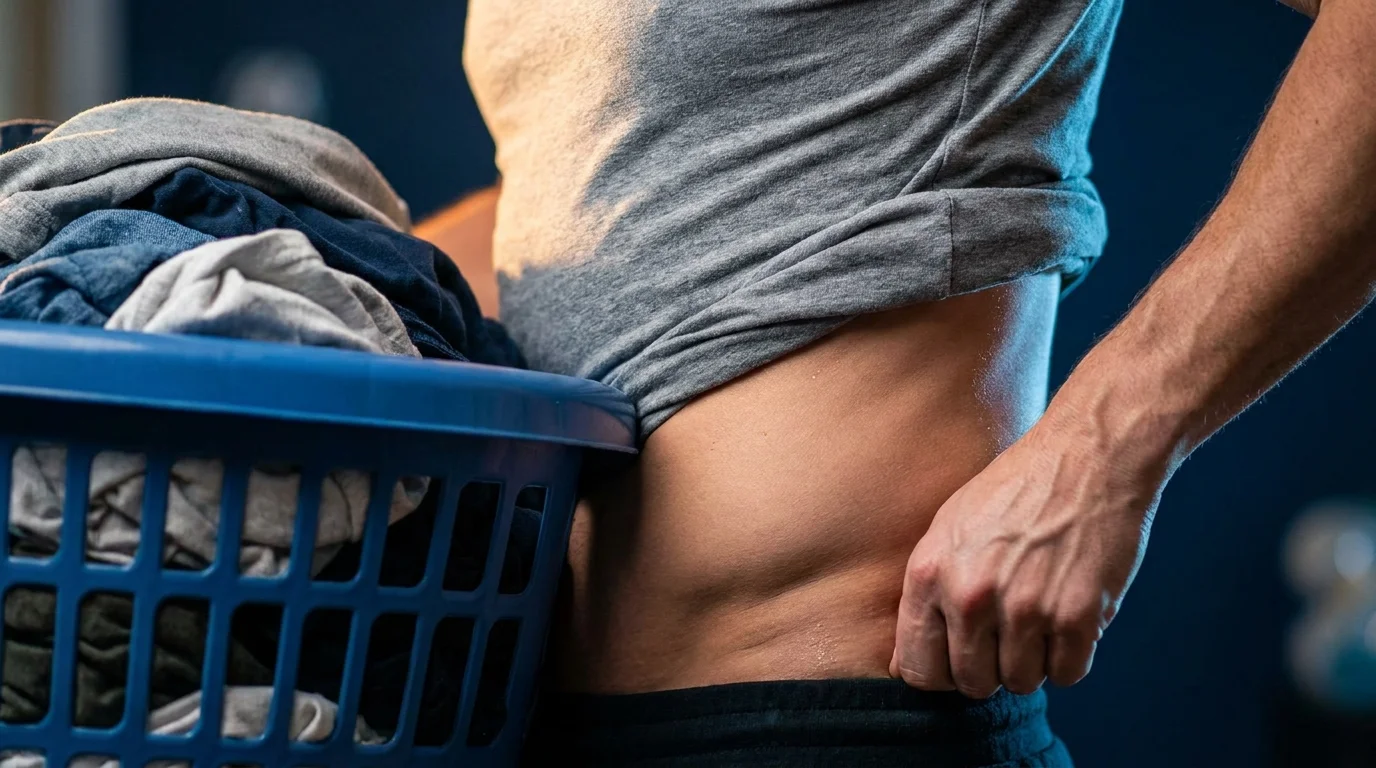
The dull thud of the washing machine door clicking shut usually signals relief. You gather the mountain of damp cotton, heave the loaded plastic hamper against your side, and balance its ridged lip directly against your right pelvic bone. You swing your hip outward like a built-in shelf, hiking your shoulder upward to counterbalance the weight while your free arm swings open doors and clears the hallway. It feels like an ordinary household shortcut.
By evening, a persistent, chewing ache settles deep into the crease of your groin. Your lower lumbar spine stiffens, refusing to let you bend forward without a twinge of sharpness that makes you reach for the kitchen counter. You blame bad mattress support, poor desk ergonomics, or advancing years for the sudden catch in your stride. Yet the actual mechanical saboteur sits silently on your utility room floor.
A brim-filled hamper rarely stays light; soaked bath sheets and heavy denim easily tip past twenty-five pounds. When you prop that awkward mass on one side of your pelvis, your spine violently buckles laterally to keep your skull level. That unconscious tilt wedges delicate facet joints together, pinches stabilizing nerves, and forces one hip socket to grind under lopsided shear pressure it was never framed to endure.
The Lever Arm Trap and the Tilted Basin
Imagine your pelvis as a balanced bowl filled to the brim with water. In an upright, centered stance, the fluid stays calm and level, distributing the weight of your torso evenly down through both femoral heads into your legs. The moment you kick one hip outward to carry an awkward load, you deliberately tip that bowl sideways, spilling tension straight into your lower back.
Your body hates walking off-balance. To prevent you from toppling over, your deep quadratus lumborum muscles along your waistline grab hold in a panic, clamping down with the force of an iron vice. Meanwhile, the opposite gluteal stabilizers shut off, leaving the weight-bearing hip socket to bear the entire load without cushioned muscular damping. Over weeks of clean linen days, the cartilage faces constant friction, setting off localized inflammation that reads like sudden arthritis.
This isn’t merely muscle soreness; it is an asymmetrical shearing force. Each stair you climb with a hamper hitched onto your flank sends an uneven shockwave through the sacroiliac joint. The joint gradually loses its micro-glide, locking into a jammed position that leaves you feeling stiff, crooked, and fragile every time you step out of a car or rise from your favorite armchair.
- Back pocket wallets tilt seated pelvis angles and trigger burning lower back aches
- Chlorthalidone pill batches face urgent recall over faulty dissolution testing failures
- Ground turmeric tea soothes throbbing joint aches and clears heavy morning stiffness
- Under-desk space heaters pool lower leg blood flow triggering sudden room spins
- Blackstrap molasses spoonfuls resurfaced as proven relief for creaky winter knee joints
Sarah Lin, a 48-year-old high school librarian from Cincinnati, spent eighteen months treating what she thought was severe sciatica with heat wraps and steroid pills. Her lower back seized every Tuesday and Friday afternoon, accompanied by a burning pinch near her right hip joint that made bending to pet her dog unbearable. A biomechanics specialist asked her to simulate her routine chores and watched her hoist thirty pounds of damp bedding against her hip to navigate two flights of basement stairs. Within three weeks of splitting her laundry loads and carrying them squarely against her chest, her burning nerve pain evaporated completely.
Mapping the Structural Fallout Across Your Frame
Not every body absorbs lateral torque the same way. The strain patterns travel along existing physical vulnerabilities, magnifying small imbalances into stubborn daily discomfort depending on your build and routine habits.
For the Petite or Narrow-Pelvis Frame
If you possess a narrower pelvic girdle, your hips offer less surface area to rest a bulky basket against, forcing you to kick your leg out at an extreme angle. This deep lateral lean drastically pinches the sub-gluteal nerves against bone. The result is often a sharp, burning tingle running down the outer seam of your thigh, frequently misdiagnosed as true sciatic nerve compression.
For the Hypermobile or Naturally Flexible Body
Those with loose, accommodating ligaments often find it remarkably easy to hoist a hamper on their hip without feeling an immediate muscular tweak. But that flexibility is a quiet hazard. Without rigid muscular bracing, delicate hip labrum tissues pinch under the shifted femur head, eroding smooth joint margins and creating that mysterious clicking sensation when walking up hill.
For the Desk-Bound Professional
Sitting for eight hours already tightens your hip flexors and shortens the iliopsoas complex. When you abruptly stand up and load twenty pounds onto one hip during a quick chore break, your spine cannot extend cleanly to compensate. Instead, it hyperextends diagonally, jamming the lumbar facet joints together and leaving you locked in an agonizing, hunched posture before dinner.
The Two-Hand Symmetrical Carry Protocol
Reclaiming healthy hip mechanics does not require abandoning clean clothes or buying industrial laundry chutes. It asks only for a deliberate pivot toward symmetry and leverage. By moving the weight closer to your center of gravity, you instantly deactivate the compensatory spasms in your flank.
Begin by dividing damp loads into smaller, manageable bundles instead of cramming an entire washing machine run into a single cavernous plastic bin. Wet fabrics absorb extraordinary moisture weight, turning towels into dense, unyielding bricks that crush joints.
- Hold the basket dead center: Keep the hamper pressed squarely against your lower abdomen with both elbows tucked close to your ribs, rather than held out away from your torso like a tray.
- Engage your abdominal wall: Pull your navel gently toward your spine before lifting, creating a firm internal pillar of pressure that shields your lumbar vertebrae.
- Step with intent, not swing: Walk with your toes pointing forward, avoiding the wide waddle that develops when carrying wide objects against your knees.
- Pivot with your feet: Never twist your spine while holding a full basket. Turn your entire body by shuffling your shoes when moving from washer to dryer.
Keep a tactical benchmark in mind whenever you haul linens. If the basket is so wide that your hands sit wider than your shoulder blades, you are fighting physics instead of working with it. Use two smaller canvas totes with soft straps, carrying one in each hand like a matched pair of grocery bags. Balanced weight neutralizes joint shearing, keeping your pelvis floating level with every step.
The Deeper Ease of Mechanical Respect
We often treat household labor as mindless background noise, rushing through physical chores while our heads remain tangled in work emails or family logistics. But your skeletal frame keeps an honest ledger. It registers every careless twist, every rushed stair ascent, and every time you use your bone structure as a convenient coat rack for chores.
When you shift the hamper to your center line, you are doing more than sparing your hip sockets from premature wear. You are practicing a quiet, grounding respect for your physical vessel. The chore ceases to be a frantic wrestling match against gravity and becomes an opportunity to move with poised, balanced grace, preserving the fluid freedom of your joints for the miles that lie ahead.
Small, repetitive chore angles dictate long-term joint longevity far more than any single heavy lifting session at the gym.
| Key Point | Detail | Added Value for the Reader |
|---|---|---|
| Hip Hoisting Mechanics | Causes severe lateral spinal compression and lopsided pelvis tilt. | Pinpoints the hidden domestic source of stubborn morning lower back stiffness. |
| Two-Tote Strategy | Splits a large load into two balanced weights carried at your sides. | Eliminates spinal torque entirely while keeping hallway vision clear and safe. |
| Front-Center Carry | Presses the load directly against the core with elbows pinned tight. | Engages supportive postural muscles and prevents groin and labrum pinching. |
Frequently Asked Questions
Why does carrying laundry on my hip cause pain on the opposite side of my lower back?
When you jut your right hip out to hold a basket, the muscles on your left flank—primarily the quadratus lumborum—must contract violently to stop your torso from tipping over. This chronic contraction leads to rigid knots and nagging aches on the opposite side.Is rolling laundry hampers on wheels a better alternative?
Yes, rolling hampers dramatically reduce joint strain, provided the handle is tall enough that you do not hunch forward while pulling it. However, if your home has stairs, two balanced tote bags remain the safer biomechanical option.How can I tell if my hip pain is from muscle fatigue or joint inflammation?
Muscular fatigue usually presents as a broad, dull ache across the flank or buttocks that eases with gentle heat and stretching. Deep joint inflammation often feels like a sharp pinch or toothache deep in the groin crease when bearing weight.What is the maximum safe weight for a single laundry hamper load?
For general joint protection, try to keep handheld chore loads below fifteen to twenty pounds. Wet towels and heavy bedding should always be divided into two separate trips rather than hauled all at once.Can carrying a child on one hip cause the exact same damage?
Absolutely. The biomechanics of carrying a toddler on your hip are identical to carrying an awkward laundry basket. It forces identical lateral spine shearing and hip socket compression, which is why parents frequently suffer identical one-sided back pain.