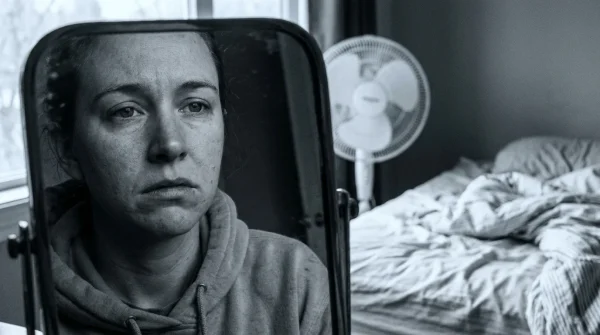
A bright pink foam roller sits wedged into the corner of a sterile office cubicle, looking like an abandoned toy in a concrete playground. The dull hum of fluorescent lights mixes with the rhythmic, soft clack of mechanical keyboards. You lean forward, massaging a persistent, deep ache in your left hip that feels like a rusted hinge. You have rolled, stretched, and walked around the floor three times today, yet the tightness refuses to budge. The real culprit isn’t your sitting posture or your office chair; it is the silent, subconscious grip you maintain while staring at your monitor.
Every time a new email banner slides into the corner of your screen, your breath pauses. It is a subtle, modern survival reflex: a mini-freeze response to a digital demand. As your chest tightens and your collarbones rise, your lower body stabilizes itself against the perceived threat. Your pelvis, acting as a structural anchor, bears the brunt of this quiet panic. Without your conscious awareness, those internal muscles tighten, leaving you to hold a physical knot that no foam roller can ever reach.
This is not a failure of strength, but an overabundance of protection. Your body is trying to keep you steady in a storm of micro-decisions, from responding to an urgent message to managing a tense calendar conflict. By understanding this somatic loop, you can finally stop fighting your own skeleton and begin releasing the tension at its true source.
The Hidden Basin of Your Everyday Choices
Imagine your pelvis as a shallow bowl cradling a delicate, highly responsive hammock of muscle and tissue. This hammock does not just support your organs; it acts as a sensitive emotional barometer that reacts to every spike in cognitive load. When you face an overwhelming inbox, your brain registers the mental fatigue as a physical challenge. Instead of breathing naturally into your belly, you engage in email apnea—a shallow pattern of chest breathing that sends a constant signal of threat down your spinal column.
When you breathe through your shoulders, your diaphragm stops moving downward. This lack of movement deprives your lower abdomen of its natural, rhythmic expansion and contraction. To compensate, the pelvic floor muscles freeze in a state of high tension to maintain core stability. Over hours and weeks, this constant, low-level contraction pulls on your tailbone and hip sockets, creating a persistent ache that mimics a structural injury. Stretching your hamstrings or glutes will only offer temporary relief because the core command center—your nervous system—is still screaming for protection.
- Habit stacking routines actually destroy your natural motivation for simple tasks
- Mood tracking apps trick your brain into constant stress and hyper-vigilance
- True crime podcasts during your commute drain your baseline energy levels
- Morning matcha lattes silently block the minerals keeping your hair thick
- Almond flour baking swaps accelerate volume loss in your cheeks
A Secret Shared from the Clinical Floor
Dr. Joanna Vance, a pelvic health physical therapist in Denver, treats hundreds of desk-bound professionals who arrive at her clinic convinced they have torn cartilage or severe hip bursitis. She recalls Sarah, a thirty-seven-year-old financial analyst who lived with constant, burning hip pain that made sitting through afternoon meetings agonizing. Sarah spent a small fortune on deep tissue massage and specialized hip mobility classes, but the relief lasted only until her Monday morning stand-up meeting. It was only when Vance began to track her breathing patterns during a simulated typing test that the pattern emerged: Sarah held her breath for up to fifteen seconds every time she opened an unread email, causing her pelvic floor to contract by nearly forty percent. Once they retrained her nervous system to breathe through her emails, her structural hip pain dissolved within three weeks.
Choosing Your Stress Release Profile
The Cubicle Analyst
For those who spend their days navigating complex spreadsheets and tight deadlines, tension accumulates quietly. Your hips lock up because your brain is trying to stabilize your body against the mental weight of constant decisions. Focusing on belly expansion during active working hours is your primary tool to interrupt this loop.
The Constant Caregiver
If you find yourself constantly managing the needs of others, you likely hold your breath to stay alert to your environment. This hyper-vigilance causes your lower abdomen to tuck inward, creating a perpetual clench. Your body needs moments of passive release where you are not required to hold anything or anyone together.
Releasing the Grip: A Daily De-escalation Protocol
To break this subconscious loop, you must show your nervous system that it is safe to let go of its structural shield. This does not require hours of dedicated exercise, but rather small, mindful shifts in how you interact with your workspace. By pairing physical relaxation with daily triggers, you turn routine tasks into somatic releases.
- The Email Exhale: Every time you click send on a message, lean back slightly and let your belly soften completely, allowing a deep, five-second breath to expand your lower abdomen.
- The Soft Seat Check: Twice an hour, actively feel the weight of your sitz bones sinking fully into your office chair, releasing any tension in your thighs and lower abdomen.
- The Diaphragm Drop: Place one hand on your belly and one on your chest; ensure the hand on your belly rises first with every breath you take while reading documents.
Our quick-reference tactical protocol helps you reset your pelvic alignment during your workday to quiet the internal alarm system and restore ease to your hips and back.
The True Source of Structural Ease
Real physical relief does not come from trying to stretch or force your muscles into submission with aggressive tools. It comes from realizing that your body’s tightness is actually a form of deep communication. When your hips ache, they are often simply asking you to take a slow, full breath in the middle of a chaotic day. Listening to these quiet physical whispers allows you to reclaim your physical comfort and move through your work with a sense of ease that no office chair upgrade can ever provide. By giving yourself permission to soften during stressful moments, you reclaim both your physical comfort and your peace of mind.
“The body does not lie; when the mind is forced to hold a dozen choices at once, the deep muscles of the pelvis will bear the weight of what is left unsaid.” — Dr. Joanna Vance
| Key Point | Detail | Added Value for the Reader |
|---|---|---|
| The Email Exhale | Release your belly completely when sending messages. | Breaks the subconscious holding pattern before it triggers pelvic muscle guarding. |
| The Jaw Release | Separate your teeth and soften your jaw during video calls. | Neurologically signals the pelvic bowl to unclench due to shared fascial pathways. |
| Sit Bone Grounding | Feel your weight drop into your chair twice an hour. | Restores natural alignment and takes the pressure off your lower back. |
Frequently Asked Questions
Can a tight pelvic floor actually cause pain in my knees and outer hips? Yes, because a contracted pelvic floor pulls on the deep rotators of your hips, altering your walking gait and placing uneven pressure on your joints.
How can I tell if I am holding my breath at my desk? Set a silent timer on your phone for every fifteen minutes; when it vibrates, notice if your breath is trapped in your chest or if your belly is moving.
Will traditional glute stretches make pelvic floor tension worse? Often, yes, because pulling on already irritated, tight tissues can trigger a guarding reflex, causing the muscles to contract harder.
Does jaw clenching have anything to do with my hip pain? Absolutely; developmentally and neurologically, the tissues of the jaw and the pelvic floor are deeply connected, meaning a tight jaw triggers pelvic tightness.
How long does it take to see relief from these breathing adjustments? Many people notice a significant reduction in deep, nagging hip and lower back pain within seven to ten days of consistent, mindful belly breathing.